Germany
Georg von Küchler
Commander of the Third Army (1939), the Eighteenth Army (1939–1942) and Army Group North (1942–1944)
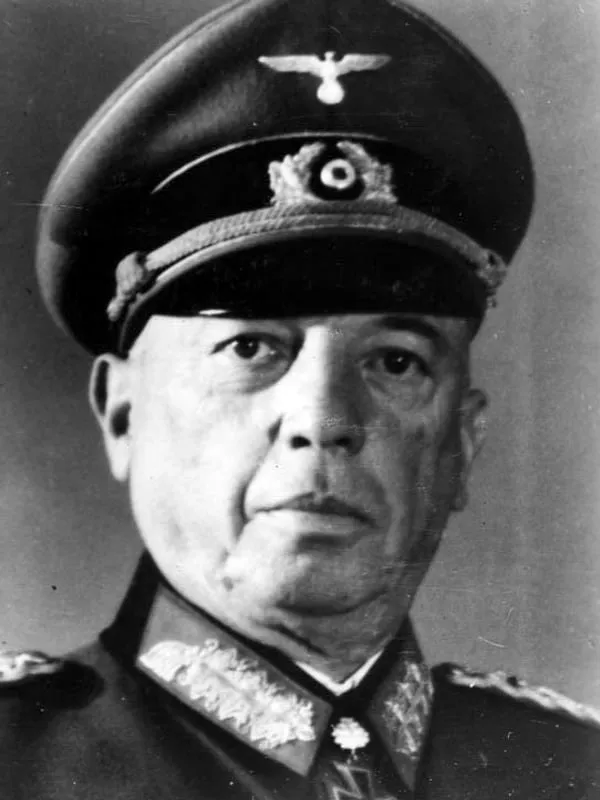
- Born:
- 30 May 1881, Philippsruhe Castle near Hanau (Germany)
- Died:
- 25 May 1968, Garmisch-Partenkirchen (West Germany)
- Author:
- Natalia
- Photo:
- Piepen, Hans van der, CC BY-SA 3.0 DE, Wikimedia Commons

Georg von Küchler was one of those German generals whose troops took part in every one of the first great campaigns. On 1 September 1939 his Third Army struck from East Prussia at Mława and approached Warsaw from the east; in May 1940 the Eighteenth Army defeated the Netherlands in five days, and in 1941 it marched through the Baltic states to Leningrad. From January 1942 to January 1944 Küchler commanded Army Group North, which tried to starve the city into submission by blockade and shelling. After the war an American tribunal at Nuremberg sentenced him to 20 years’ imprisonment for war crimes and crimes against humanity.
A gunner from Hesse
Georg Carl Wilhelm Friedrich von Küchler was born on 30 May 1881 at Philippsruhe Castle near Hanau, into the family of a Hessian colonel and court marshal. After leaving school in Darmstadt, in 1900, he joined a Hessian field artillery regiment and in 1901 was commissioned as a second lieutenant. He attended the riding school in Hanover and the war academy, and at the beginning of 1914 he joined the Great General Staff. During the First World War he commanded a battery for a short time and then served for four years on staffs on the Western Front, towards the end of the war as first staff officer of an infantry division. In 1919 he fought in Latvia and Lithuania in the volunteer “Courland Brigade”, one of the Freikorps (PL) formations that tried to preserve German influence in the Baltic states.
In the Reichswehr he dealt mainly with training: he taught at the infantry and artillery schools, worked in the ministry, and in 1931 was promoted to colonel. From 1932 he was artillery commander of the military district in East Prussia, in 1935–1936 inspector of war schools, and for half a year vice-president of the Reich Military Court. On 1 April 1937, as a general of artillery, he took over I Corps and the district command in Königsberg. On 23 March 1939 his soldiers marched into Klaipėda (Memel), taken from Lithuania.
The Third Army in September 1939
In the September Campaign the district headquarters became the headquarters of the Third Army, part of Fedor von Bock’s Army Group North. Its main forces attacked the position of the Modlin Army at Mława, where for three days they failed to break through. Küchler then shifted the weight of the attack eastwards, towards Różan and Pułtusk, crossed the Narew and outflanked Warsaw from the east. His troops encircled the capital from the Praga side, and on 16 September he sent an envoy into the city demanding unconditional surrender. According to the “Neue Deutsche Biographie” he considered an assault on Praga unnecessary, since Poland’s defeat was already certain. On 30 September he received the Knight’s Cross.
Shortly after the campaign Küchler lost his command for a time. The sources give two reasons, which probably overlapped: at a memorial service he organised for General Werner von Fritsch, killed outside Warsaw, he sharply criticised those who had slandered Fritsch in 1938, and in East Prussia he reportedly refused Gauleiter Erich Koch the use of troops against Polish and Jewish civilians. The army’s commander-in-chief, Walther von Brauchitsch, soon gave him the newly formed Eighteenth Army, however.
The Netherlands, Dunkirk, Paris
On 10 May 1940 the Eighteenth Army attacked the Netherlands. Küchler, fearing a British landing and wanting to link up with the paratroopers as quickly as possible, on 13 May ordered the commander of XXXIX Corps to break the resistance of Rotterdam by every means. The next day came the bombing of the city, which destroyed its old centre. On 15 May, at his headquarters in the village of Rijsoord, General Henri Winkelman signed the capitulation of the Dutch army (see Dutch campaign). According to the NDB Küchler made an effort to ensure that the capitulation was not humiliating. The Eighteenth Army then crossed Belgium, took Antwerp and at the end of May took over the siege of Dunkirk. On 14 June its troops entered Paris; according to the NDB Küchler had demanded by radio that the city surrender without a fight, which saved it from destruction. On 19 July 1940 he was promoted to colonel general.
In the summer of 1940, when the Eighteenth Army was moved east to occupied Poland, Küchler forbade his officers to criticise the “ethnic struggle” being waged in the General Government against Poles and Jews, explaining that it required exceptionally harsh measures. He knew in detail about the crimes being committed in Poland.
Through the Baltic to Leningrad
Preparing for the attack on the USSR, Küchler told his divisional commanders in April 1941 that Russia was separated from Germany by a deep ideological and racial “abyss”, and that the aim of the war was not to push Russia back but to destroy European Russia; he called Red Army commissars criminals who should be shot, and passed on the Commissar Order with approval. In Operation Barbarossa the Eighteenth Army advanced along the coast within Wilhelm von Leeb’s Army Group North: it took Riga, overran Estonia and reached the Gulf of Finland. In September its divisions closed the ring around Leningrad from the south and west.
Behind the army’s lines operated Einsatzgruppe A, which murdered Jews in the Baltic states and the occupied Russian territories; according to German research Küchler supported the mass executions. In December 1941, with his consent, a unit of the Security Police and SD shot some 230 female patients of an institution for the mentally ill in the former monastery at Makaryevo; the danger of an epidemic was given as the reason.
Army Group North
In mid-January 1942, after Leeb’s resignation, Küchler took command of Army Group North, and on 30 June he became a field marshal. His troops beat off Soviet attempts to break the blockade of Leningrad, and in the summer of 1942 they destroyed the encircled 2nd Shock Army on the Volkhov. A plan to take the city in the autumn of 1942 was abandoned when the forces brought up to Leningrad had to be thrown into the defence near Lake Ladoga. In January 1943 the Red Army broke the blockade with a narrow corridor along the lake. All this time German artillery shelled the city, where, according to various estimates, between about 630,000 and more than a million inhabitants died of hunger or were killed by shells. Soviet prisoners of war in the camps behind the army group’s lines died in great numbers of hunger and cold, and the civilian population was used for forced labour on fortifications.
At the end of November 1943 Küchler proposed withdrawing his exhausted troops to the Panther Line, being built far to the west. Hitler refused. On 14 January 1944 the Leningrad–Novgorod offensive began, General Georg Lindemann’s Eighteenth Army was shattered, and the blockade finally ended. When Küchler demanded permission for a further retreat, Hitler accused him of withdrawing without orders and at the end of January replaced him with Walther Model, who within a month carried out the same retreat to Narva. Küchler was transferred to the reserve and never employed again. Conspirators from Carl Goerdeler’s circle tried to win him over, without success; after the 20 July plot he refused, despite pressure, to make a declaration of loyalty to Hitler.
Trial and final years
In May 1945 Küchler was detained by the Americans. In 1946–1947, at the camp in Garmisch, he directed part of the work of former German generals who were writing studies of the war for the US Army’s Historical Division; he advised them to combine historical truth with praise of their own army. It did not save him from prosecution. In the High Command Trial, one of the Nuremberg trials before an American tribunal, he was found guilty of, among other things, passing on the Commissar Order and the decree on military jurisdiction, tolerating the killing of prisoners of war, using prisoners and civilians for prohibited work and taking part in the persecution of the Jews. In the judgment of late October 1948 he was sentenced to 20 years’ imprisonment. In 1951 the American High Commissioner John McCloy reduced the sentence to 12 years, and in February 1953 Küchler was released from prison in Landsberg. He died on 25 May 1968 in Garmisch-Partenkirchen and was buried in Darmstadt. He wrote no memoirs, arguing that the generals who had failed to prevent Germany’s catastrophe ought to remain silent.
Assessment
Older biographies, such as the 1982 entry in the “Neue Deutsche Biographie”, portrayed Küchler as a chivalrous officer of the old school who respected the laws of war, protected the civilian population and disliked the SS. Research of recent decades, based on the records of the Eighteenth Army and Army Group North, shows a commander who accepted the ideological premises of the war against the USSR, passed on criminal orders and cooperated with the Einsatzgruppen. As a strategist he was competent and cool-headed, but his name remains linked above all with the blockade of Leningrad.
Sources
Commanded in battles
(04)Mentioned in battles
(04)Often appears with
People who appear in the same events.