Japan
Masanobu Tsuji
Operations officer of the Kwantung Army (1937–1939), head of operations of the 25th Army in Malaya (1941–1942), officer of the General Staff (1941–1943), staff officer of the 33rd Army in Burma (1944–1945)
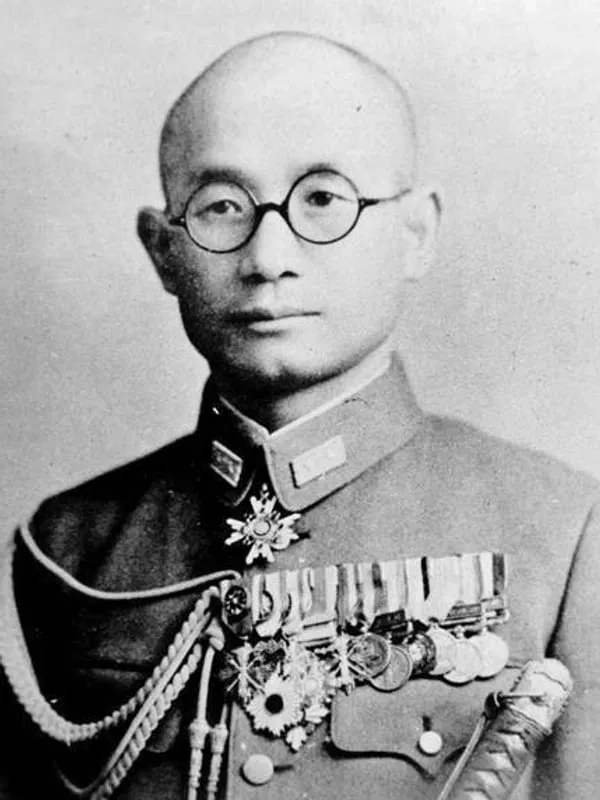
- Born:
- 11 October 1902, Kaga, Ishikawa Prefecture (Japan)
- Died:
- 1961, Laos (disappeared)
- Author:
- Natalia
- Photo:
- autor nieznany, domena publiczna, Wikimedia Commons

Masanobu Tsuji was a Japanese officer who spent the whole war on staffs rather than at the head of troops, and yet shaped the course of the war more than many generals. Intelligent, ascetic, tireless and self-confident to the point of contempt for his superiors, he embodied what the Japanese called gekokujō, “the low overthrowing the high”: middle-ranking officers who on their own initiative pushed the army and the state towards war. In 1939 he helped to start the fighting at Khalkhin Gol, in 1941 he was among the most determined advocates of war with the United States, and then he planned the victorious Malayan campaign. Historians link him to the massacre of Chinese in Singapore, the killing of prisoners on Bataan and the execution of Filipino politicians. After the war he hid from the Allies, returned to Japan as a best-selling author and member of parliament, and in 1961 vanished without trace in Laos.
Top of the class from Ishikawa
He was born on 11 October 1902 in a village within today’s city of Kaga (PL) in Ishikawa Prefecture (PL), the third of four sons. His year of birth is given variously, and Tsuji himself sometimes stated 1901. He went through the whole course of military education as the best: in 1918 he entered the cadet school in Nagoya, in July 1924 he graduated top of his class from the Military Academy, for which he received a silver watch from the emperor, and in 1931 he graduated third in his year from the Army Staff College. He was posted to the 7th Infantry Regiment at Kanazawa (PL).
In 1932 he fought in China. In 1934, as a company commander at the Military Academy, he became caught up in the army’s factional struggle: with the help of the cadets under him he brought to light a plot by young officers of the Kōdō-ha faction. This won him the favour of their opponents, among them Generals Hideki Tōjō and Seishirō Itagaki, who over the following years shielded him from the consequences of his insubordination.
Nomonhan
From 1936 Tsuji served on the staff of the Kwantung Army in Manchukuo, from November 1937 in its operations section, and in March 1938 he became a major. In the spring of 1939, after the fighting at Lake Khasan, humiliating for the army, he wrote the principles for handling border disputes with the USSR that the army commander, General Kenkichi Ueda, issued. They allowed a local commander to determine for himself the course of an unclear border and ordered him to win regardless of the enemy’s strength or the border line. When clashes broke out in May on the Khalkhin Gol river on the Mongolian border, the incident grew into a regular war. On 27 June the Kwantung Army’s air force, following Tsuji’s plan and without Tokyo’s consent, bombed Soviet airfields deep inside Mongolia.
In August the troops of Georgy Zhukov encircled and destroyed the Japanese 23rd Division, and the Battle of Khalkhin Gol ended in defeat. The Kwantung Army’s command was recalled, and Tsuji was moved to the staff of the 11th Army at Hankou. He later admitted that what he had seen at Khalkhin Gol convinced him that the Red Army should not be fought again. The conclusion he drew, however, was that Japan should strike south.
Malaya and Singapore
In August 1940 Tsuji was promoted to lieutenant colonel, and in December he went to Taiwan, to a small army research unit which in a few months gathered knowledge about tropical warfare, landings and the roads of Malaya. From July 1941 he worked in the operations section of the General Staff in Tokyo. According to General Ryūkichi Tanaka, who testified after the war, he was then the most determined advocate of war with the United States in the whole army. There were also rumours, never confirmed, that he was ready to kill Prime Minister Fumimaro Konoe if Konoe reached an agreement with Washington.
In the autumn of 1941 he became head of operations of General Tomoyuki Yamashita’s 25th Army and was one of the main authors of the plan for the Malayan campaign. On 8 December, a few hours before the attack on Pearl Harbor, the Japanese landed in Malaya and in Thailand, and within ten weeks they had swept down the whole peninsula, outflanking one British position after another through the jungle and by sea. On 15 February 1942, after the Battle of Singapore, General Arthur Percival capitulated. After the war Tsuji described the campaign in a book also published in English, still one of the essential Japanese accounts.
The victory had a dark side. From 18 February the Kempeitai military police and units of the 25th Army carried out in Singapore, and then in Malaya, a “purge” of the Chinese population known as Sook Ching. Men deemed “anti-Japanese” after cursory screenings were taken to the beaches and shot. The Japanese command admitted after the war to some 5,000–6,000 victims; Singaporean and Chinese estimates speak of tens of thousands. The details of the order were settled by the army’s chief of staff, Sōsaku Suzuki, and by Tsuji, and according to many historians Tsuji was the chief instigator of the massacre and pressed officers to kill more. Japanese historians dispute the exact extent of his responsibility. After the war a British court in Singapore convicted several officers for Sook Ching; Tsuji was then in hiding.
Bataan, Guadalcanal and New Guinea
In March 1942 Tsuji returned to the operations section of the General Staff, and in April he went to the Philippines, where General Masaharu Homma’s 14th Army was finishing the fighting on Bataan. According to the accounts of Japanese officers, he passed on verbal instructions, invoking Imperial General Headquarters, to shoot prisoners whose surrender had not been formally accepted. Some commanders refused, but at the Pantingan River the officers and NCOs of the Filipino 91st Division were massacred. Many historians write about Tsuji’s role in the atrocities of the death march, although there are no direct written orders. He is also credited with the pressure that led in May 1942 to the execution of the Chief Justice, José Abad Santos, captured on Cebu, and with an attempt to have Manuel Roxas, later President of the Philippines, executed, which other officers prevented.
In the summer of 1942 Tsuji, as the representative of the General Staff, appeared at the 17th Army’s headquarters in Davao and on 15 July announced that the study of an overland route to Port Moresby had been turned into an order to carry out the operation. According to Japanese studies he acted on his own authority, but nobody in Tokyo cancelled the order. So began the landings at Buna and Gona and the gruelling fighting on the Kokoda Track. Tsuji visited the front and was wounded in an air raid near Buna.
In the autumn of 1942 he flew to Guadalcanal to help General Harukichi Hyakutake’s 17th Army retake Henderson Field. He was a co-author of the plan for a night attack, for which the 2nd Division spent many days hacking its way through the jungle along a trail cut behind the Americans. The attack in the last days of October collapsed under the defenders’ fire with heavy losses. Sick with malaria, Tsuji returned to Tokyo, where he first demanded reinforcements and then admitted that the island could not be held and supported evacuation. The Guadalcanal campaign damaged his reputation. In February 1943 he became an instructor at the Army Staff College.
China and Burma
In August 1943 Tsuji was promoted to colonel and took up a post on the staff of the China Expeditionary Army in Nanking, commanded by Field Marshal Shunroku Hata. There he made contacts both with collaborators and with agents of Chiang Kai-shek’s government, which proved useful to him after the war. In July 1944, after the defeat at Imphal, he was transferred to the staff of the 33rd Army in north-eastern Burma, which was holding out against Chinese forces from Yunnan and India. According to accounts cited in Japanese literature, it was Tsuji who drafted the order that required General Mizukami to defend Myitkyina personally to the death; after getting part of the garrison out, Mizukami committed suicide. Tsuji also devised a counter-offensive in Yunnan, Operation Dan, intended to relieve the besieged garrisons during the Salween offensive; after initial successes it failed to stop the Chinese.
Burma was also the setting of the most repellent of the stories about him: according to witnesses he ate the liver of a downed Allied airman, claiming that it would fill the soldiers with hatred of the enemy. The story comes from post-war recollections and was never confirmed in any trial. In 1945 Tsuji was a staff officer of the 18th Area Army in Bangkok, where the end of the war found him.
Flight, politics and disappearance
On 14 August 1945, with the consent of his superior, Tsuji disappeared. Disguised as a Buddhist monk, he hid in Thailand, and at the end of the year made his way via Hanoi to Chongqing, where he worked for the intelligence service of the Kuomintang. The British were looking for him as a suspect for the crimes in Singapore. In 1948 he returned to Japan and stayed in hiding until in 1949 he was removed from the wanted list. In 1950 he published his memoir of life in hiding, Senkō sanzenri, which became a best seller, followed by books on Malaya, Nomonhan, Guadalcanal and Burma. American military intelligence saw him as a valuable informant; the CIA, whose files were declassified in 2005–2006, regarded him as a worthless adventurer and wrote in 1954 that he was the kind of man who, given the chance, would start a third world war without hesitation.
In October 1952 Tsuji was elected to the House of Representatives (PL) for a constituency in Ishikawa Prefecture and was re-elected several times. In 1959 he was expelled from the Liberal Democratic Party for attacking Prime Minister Nobusuke Kishi, but in June that year he won a seat in the House of Councillors (PL). On 4 April 1961 he set off on a study tour of South-East Asia. He was last seen on 21 April in Laos (PL), then in the grip of civil war, when, disguised as a monk, he left Vientiane heading north towards areas controlled by the Pathet Lao (PL). His fate remains unknown: according to some accounts he was killed by communist guerrillas; according to CIA files, based on an unreliable source, he was kidnapped and held in China’s Yunnan province. In 1969 a Tokyo court, at his family’s request, declared him dead as of 20 July 1968.
Assessment
Tsuji was one of the most gifted planners of the Japanese army and one of its most harmful officers. The Malayan campaign he helped to create inflicted on Britain the greatest defeat in its military history. The same qualities that brought him success, namely audacity, disregard for orders and risk, and a fanatical faith in the soldier’s spirit, led thousands of men to their deaths at Nomonhan, on Guadalcanal and on the Kokoda Track. The historian John Dower called him a fanatical ideologue and a pathologically brutal staff officer. Tsuji never stood trial for any of the crimes associated with his name, and in post-war Japan he enjoyed popularity for years as an author and politician.
Sources
Mentioned in battles
(05)Often appears with
People who appear in the same events.
On the timeline
(10)1939
1941
December
- 08
- The Japanese invasion of ThailandOn 8 December 1941 the Japanese landed on the Thai coast and crossed from Indochina. After hours of fighting, Bangkok ceased fire and let them pass to Malaya.
- The Malayan campaign beginsJust after midnight on 8 December 1941 the Japanese landed at Kota Bharu in Malaya and in Thailand. Five days later Yamashita's army beat the British at Jitra.