Soviet Union
Rodion Malinovsky
Commander of the Southern Front (1941–1942, 1943), 2nd Guards Army (1942–1943), Southwestern and 3rd Ukrainian Fronts (1943–1944), 2nd Ukrainian Front (1944–1945) and Transbaikal Front (1945), Marshal of the Soviet Union (from 1944)
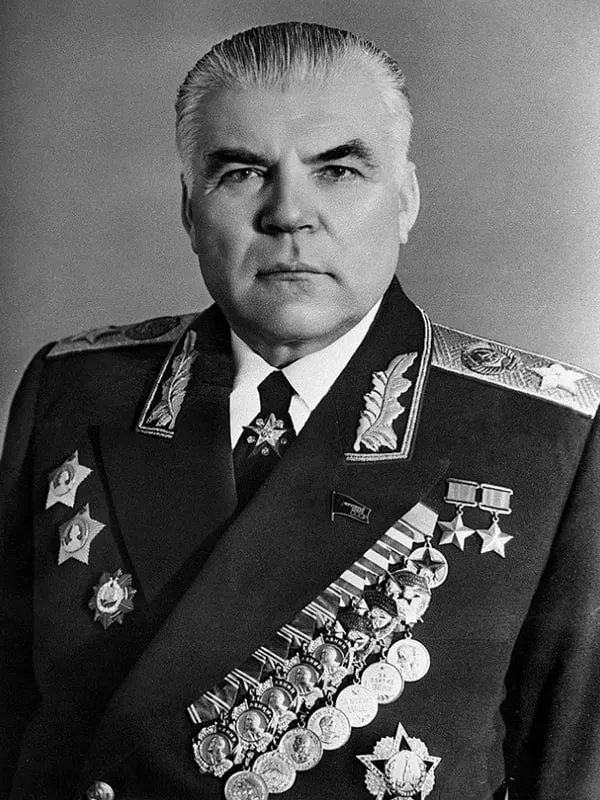
- Born:
- 23 November 1898, Odessa (Ukraine; then the Russian Empire)
- Died:
- 31 March 1967, Moscow (Soviet Union)
- Author:
- Łukasz
- Photo:
- autor nieznany, CC BY 4.0, Wikimedia Commons

Rodion Malinovsky was one of the most effective Red Army front commanders of the second half of the war. A boy from Odessa who ran away to the front at fifteen, he fought in the First World War in France and in the 1930s in Spain; in the first year of the war with Germany he shared the Red Army’s defeats in the south and drew the suspicion of Joseph Stalin. He restored his standing in December 1942, when his 2nd Guards Army stopped the German attempt to relieve the 6th Army encircled at Stalingrad. He then led his troops through the Donbas, southern Ukraine, Romania, Hungary, Austria and Czechoslovakia, and in the summer of 1945 he struck the main blow against the Kwantung Army in Manchuria. After the war he was Soviet Minister of Defence for almost ten years.
Odessa, Smorgon and Champagne
He was born on 23 November 1898 in Odessa (a day earlier according to the parish register), the illegitimate son of a seamstress; he never knew his father. He spent his childhood in a Podolian village, where he worked as a farmhand, and then returned to Odessa as an apprentice in a shop. In 1914 he talked soldiers bound for the front into taking him on their troop train and became a volunteer in the machine-gun company of the 256th Infantry Regiment. For a fight near Kalwaria he won the Cross of St George, 4th class, and in October 1915 he was badly wounded near Smorgon.
In 1916 he joined the Russian Expeditionary Force (PL), which was shipped to France by way of China, the Indian Ocean and the Suez Canal. In April 1917, in Champagne, he was again seriously wounded. After the mutiny of the Russian brigades at the La Courtine camp, in which he took no part, he was suspected of complicity and sent to forced labour. From January 1918 he fought in the Russian Legion attached to the French Moroccan Division until the armistice, and won the French Croix de Guerre for the fighting in Picardy. He returned to Russia in the autumn of 1919 by way of Vladivostok, made his way across Kolchak’s Siberia and crossed the front line. Red Army men who found his French decorations very nearly shot him.
Between the wars and Spain
In November 1919 he joined the Red Army and, as a machine-gun instructor in the 27th Rifle Division, fought against Kolchak until typhus laid him low. After the Civil War he served in Siberia and central Russia, joined the party in 1926 and in 1930 graduated from the Frunze Military Academy. For several years he worked on the staffs of the North Caucasus and Belorussian Military Districts, and in 1935–1936 he was chief of staff of the 3rd Cavalry Corps.
From January 1937 to May 1938, as “Colonel Malino”, he advised the Republicans in the Spanish Civil War. He took part in the defence of Madrid and in the fighting on the Jarama and at Guadalajara, for which he received the Order of Lenin and the Order of the Red Banner. He spoke fluent French and Spanish. He came home during the Great Purge but escaped it. From 1939 he taught at the Frunze Academy, and in June 1940 he was made a major general.
Defeats in the south
In March 1941 he took over the 48th Rifle Corps on the Prut, on the Romanian border. After Germany and Romania attacked, the corps fell back along the Black Sea coast, broke out of encirclement near Nikolayev and reached the Dnieper. In August Malinovsky took command of the 6th Army, in November he became a lieutenant general, and on 24 December 1941 he was given the Southern Front. In January 1942 his troops, together with the Southwestern Front, drove a wedge into the German defences south of Kharkov, creating a salient around Barvenkovo.
It was from this salient that the offensive on Kharkov, led by Marshal Semyon Timoshenko, set out in May 1942. Malinovsky’s front was to cover its southern face. The commander of the 9th Army asked for anti-tank defences to be built up on this sector, but according to Soviet accounts he was refused. On 17 May it was precisely there that Ewald von Kleist’s panzer group struck, and the troops in the salient were encircled and destroyed.
In July the Germans began their summer offensive towards the Caucasus and the Volga. The Southern Front, its right flank laid bare, retreated in disorder through the Donbas, and on 23–24 July 1942 the Germans took Rostov. According to some Russian writers Malinovsky pulled his troops back across the Don without waiting for orders and saved them from encirclement. Stalin, however, was furious: Order No. 227, “Not a step back”, issued on 28 July, cited the surrender of Rostov and Novocherkassk without serious resistance as an example of disgrace. The same day the Southern Front was disbanded and its troops passed to the North Caucasus Front, in which Malinovsky became deputy commander. According to Nikita Khrushchev, Stalin at that time suspected that a general who had spent years in France might be a foreign agent.
Stalingrad and Rostov
At the end of August 1942 Malinovsky was given the new 66th Army north of Stalingrad. In September and October it attacked the German corridor between the Don and the Volga near Kotluban. It gained little ground but tied down German forces during the Battle of Stalingrad. Khrushchev, a member of the front’s military council, had, according to his memoirs, been told by Stalin to keep an eye on him. Malinovsky was briefly deputy commander of the Voronezh Front, and on 29 November 1942 he took over the 2nd Guards Army, the strongest formation in the High Command reserve, with three corps and some 90,000 men.
The army was meant to destroy the encircled 6th Army, but on 12 December the German relief attempt, Operation Winter Storm, set out from Kotelnikovo. The Chief of the General Staff, Aleksandr Vasilevsky, persuaded Stalin to throw the 2nd Guards Army across the path of Hermann Hoth’s tanks. Its divisions marched on foot across the steppe in the frost and took up positions on the Myshkova river, where the German attack stalled a few dozen kilometres from the pocket. On 24 December Malinovsky’s army went over to the counter-attack and threw the Germans back beyond Kotelnikovo. The fate of the 6th Army was sealed, and Malinovsky received the Order of Suvorov, 1st class, and in February 1943 the rank of colonel general.
On 2 February 1943 he took over the Southern Front again, and on 14 February his troops liberated Rostov. The pursuit stopped, however, on the Mius river, on lines the Germans had fortified back in 1941.
The Donbas, the Dnieper and Odessa
On 22 March 1943 Malinovsky took command of the Southwestern Front, and in April he became a general of the army. In the summer his troops attacked in the Donbas, and in the autumn they reached the Dnieper as part of the Battle of the Dnieper. On 14 October 1943, after a night assault, they took Zaporozhye, which helped break the German defences at Melitopol and cut off the Crimea, and on 25 October they entered Dnepropetrovsk. From 20 October the front was called the 3rd Ukrainian Front.
In the winter and spring of 1944 the front fought for Nikopol and Krivoi Rog, crossed the Southern Bug and on 28 March took Nikolayev. On 10 April its troops entered Odessa, their commander’s home city, ending two and a half years of Romanian occupation there.
Romania and Hungary
On 15 May 1944 Malinovsky took over from Ivan Konev the stronger 2nd Ukrainian Front, which stood on the Romanian border. On 20 August, together with Fyodor Tolbukhin’s 3rd Ukrainian Front, he launched the Jassy–Kishinev offensive, one of the best-executed operations of the Red Army. Within days the German 6th Army was encircled, the Romanian armies fell apart, and on 23 August King Michael I ordered the arrest of Marshal Ion Antonescu and Romania changed sides. On 31 August troops of the 2nd Ukrainian Front entered Bucharest. On 10 September 1944 Malinovsky was made a Marshal of the Soviet Union, and two days later he signed the armistice with Romania in Moscow on behalf of the three Great Powers.
In the autumn his front crossed the Southern Carpathians, and in October it fought the Battle of Debrecen on the Hungarian Plain. On 28 October Stalin, who wanted to take Budapest as quickly as possible, ordered him to attack the city straight off the march, although his troops were exhausted. The quick blow failed. Only on 26 December did the troops of Malinovsky and Tolbukhin close the ring around the city, and the siege of Budapest lasted until 13 February 1945. It cost tens of thousands of dead soldiers on both sides and the lives of some 38,000 civilians. The Red Army’s entry into Hungary was accompanied by mass rape, looting and the deportation of civilians to forced labour in the Soviet Union, on which Soviet historiography remained silent.
In the spring of 1945 the 2nd Ukrainian Front attacked north of the Danube, in parallel with Tolbukhin’s offensive on Vienna. On 4 April it took Bratislava, and its left wing took part in the Vienna offensive. On 26 April Malinovsky’s troops entered Brno, and in May they took part in the Prague offensive. On 26 April 1945 Malinovsky received the Order of Victory.
Manchuria
After the German surrender he was sent to the Far East, where he took over the Transbaikal Front. In the Manchurian operation, under Vasilevsky’s overall command, this front struck the main blow. On 9 August 1945 it set out from Mongolia without an artillery preparation, and the 6th Guards Tank Army, sent in the first echelon, crossed the desert and the Greater Khingan mountains, which the Japanese had thought impassable to tanks. Within a few days the Soviet spearheads were hundreds of kilometres deep in Manchuria, and the Kwantung Army surrendered. On 8 September 1945 Malinovsky was made a Hero of the Soviet Union.
Minister of Defence
After the war he commanded the troops in the Far East for eleven years. In 1956 Khrushchev brought him to Moscow as commander-in-chief of the ground forces, and in October 1957, after removing Georgy Zhukov, appointed him Minister of Defence. Malinovsky led the armed forces through the Berlin crisis and the Cuban Missile Crisis and defended the importance of conventional forces against Khrushchev’s fascination with missiles. He kept his post after Khrushchev’s fall in 1964. He died in Moscow on 31 March 1967, and the urn with his ashes was placed in the Kremlin Wall. He had received his second Gold Star of a Hero in 1958.
Historians count him among the best operational commanders of the Red Army. The Jassy–Kishinev and Manchurian operations, conducted on a grand scale, at speed and with large armoured groupings, rank among the model Soviet operations of the war. His career also shows how little separated a Soviet general from ruin: the same man whom Stalin suspected of treason in July 1942 was saving the situation at Stalingrad six months later. Budapest, taken in haste and at any price on Stalin’s orders, remains the darkest point of his wartime record.
Sources
Commanded in battles
(09)- 12–23 December 1942Operation Winter StormEastern Front
- 26 August – 23 December 1943Battle of the DnieperEastern Front
- 20–29 August 1944Jassy–Kishinev offensiveEastern Front
- 6–29 October 1944Battle of DebrecenEastern Front
- 29 December 1944 – 13 February 1945Siege of BudapestEastern Front
- 6–16 March 1945Operation FrühlingserwachenEastern Front
- 16 March – 15 April 1945The Vienna offensiveEastern Front
- 6–11 May 1945The Prague offensiveEastern Front
- 9–20 August 1945The Soviet invasion of ManchuriaFar East
Mentioned in battles
(03)Often appears with
People who appear in the same events.