Germany
Walter von Reichenau
Head of the Ministerial Office and the Wehrmacht Office (1933–1935), commander of the Tenth Army (1939), the Sixth Army (1939–1941) and Army Group South (December 1941 – January 1942)
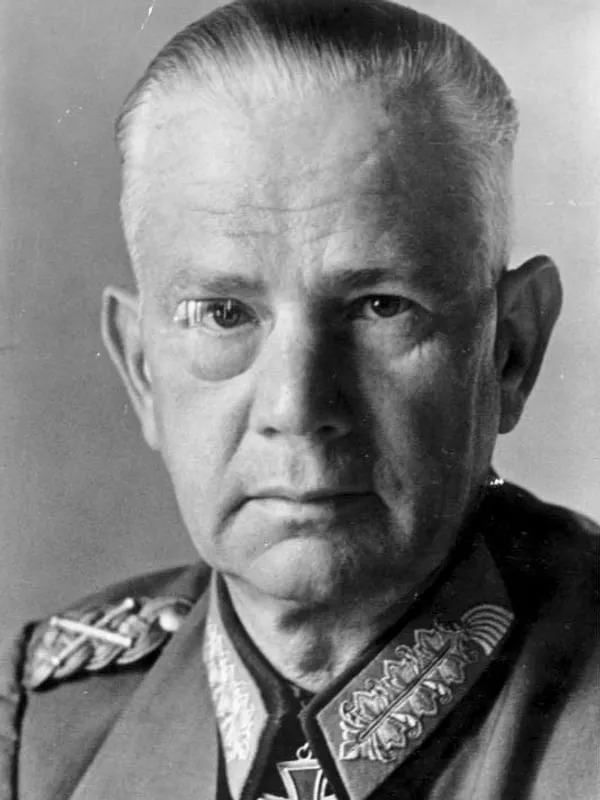
- Born:
- 8 October 1884, Karlsruhe (Germany)
- Died:
- 17 January 1942, On board an aircraft bound for Lviv (now Ukraine)
- Author:
- Łukasz
- Photo:
- autor nieznany, CC BY-SA 3.0 DE, Wikimedia Commons

Walter von Reichenau was the first senior officer of the German army to throw in his lot openly with Hitler, and the one who did most to make the army part of the Nazi state. In 1934 he had a say in the Night of the Long Knives and drafted the oath that soldiers swore personally to Hitler. In September 1939 his Tenth Army, the strongest of the invasion armies, drove from Silesia on Warsaw; in 1940 the Sixth Army forced Belgium to capitulate, and in 1941 it advanced through Kiev to Kharkov. The massacre at Babi Yar was carried out behind its lines, and Reichenau himself issued an order calling on his soldiers to exact a “severe but just atonement” from the Jews. He died in January 1942, before he could be brought to trial.
A sportsman in uniform
Walter Karl Gustav August Ernst von Reichenau was born on 8 October 1884 in Karlsruhe, the son of the Prussian lieutenant general Ernst von Reichenau. After leaving school, in 1903, he joined the 1st Guards Field Artillery Regiment. He was an untypical member of the Prussian officer caste: a keen runner and footballer who organised competitions within the Guards Corps, travelled in South America and the United States, and together with the sports official Carl Diem devised the German sports badge, awarded from 1913. Later he sat on the organising committee of the 1936 Berlin Olympics and on the International Olympic Committee. He treated sport as a means to an end, however: a good sportsman was supposed to make a good soldier.
During the First World War he was a regimental adjutant on the Western Front and from 1915 a general staff officer in several divisions; as a junior staff officer he served, among others, under General Max Hoffmann. In 1919 he married the Silesian aristocrat Alexandrine von Maltzan, sister of Maria von Maltzan (PL), who during the war hid Jews in Berlin.
The road to Hitler
In the Reichswehr Reichenau served on staffs, including that of the signals inspectorate. At the beginning of the 1930s he became chief of staff of the military district in East Prussia, under General Werner von Blomberg. In 1932 his uncle, a diplomat, introduced him to Adolf Hitler. The ambitious Reichenau saw in the Nazis a force on which he could build his own career and that of the army, and it was he who brought Blomberg close to Hitler.
When Hitler became chancellor on 30 January 1933 and Blomberg became Reichswehr minister, Reichenau took over the Ministerial Office, the key link between the army and politics, which in 1934 was turned into the Wehrmacht Office. He broke with the army’s previous neutrality under the slogan “into the new state”. At first he cooperated with the SA, but when Ernst Röhm began demanding that his stormtroopers become the new army, Reichenau, together with Blomberg, pressed Hitler to crush them. In June 1934 he took part in preparing the purge in which the leaders of the SA were killed, as well as Generals Kurt von Schleicher and Ferdinand von Bredow; afterwards he publicly repeated the official version of their treason. After Hindenburg’s death, on 2 August 1934, the army swore an oath of loyalty to Hitler, whose text Reichenau dictated to one of his officers. He was also responsible for introducing the swastika as the army’s emblem and the “Aryan paragraph”.
Twice, in 1934 and in 1938, Hitler wanted to make him commander-in-chief of the army. The first time President Hindenburg objected and chose Werner von Fritsch; the second time older generals, among them Gerd von Rundstedt, refused to serve under a zealous Nazi. In 1935 Reichenau took over VII Corps in Munich, and in February 1938 the group command in Leipzig. On 12 February 1938 he sat at the table at the Berghof while Hitler browbeat the Austrian chancellor Kurt Schuschnigg before the Anschluss. In the autumn he took part in the occupation of the Sudetenland.
The Tenth Army in Poland
In the September Campaign Reichenau commanded the Tenth Army, which concentrated most of the German armoured and motorised troops; his chief of staff was Friedrich Paulus. On 1 September the army attacked from Upper Silesia towards Warsaw, supported by the air force, which that day bombed Wieluń. On 8 September the tanks of XVI Corps reached the outskirts of Warsaw but were driven back. Reichenau’s troops closed the pocket at Radom and then turned west to close the ring on the Bzura from the east. On 30 September Reichenau received the Knight’s Cross and on 1 October promotion to colonel general.
According to the “Neue Deutsche Biographie” he protested against SS crimes against the Polish civilian population and ordered that soldiers be punished severely for looting and rape. Like other generals, he opposed the autumn offensive in the west that Hitler wanted to launch while it was still 1939.
The Sixth Army in Belgium
In May 1940 Reichenau led the Sixth Army through the Maastricht “appendix”, across the Meuse and the Albert Canal into Belgium, after paratroopers had taken the fort of Eben-Emael. His panzer corps fought a great battle with the French cavalry at Hannut, on 17 May the army took Brussels, and it then pushed the Belgian forces towards the sea. On 27 May soldiers of one of its divisions committed the Vinkt massacre, killing at least 86 civilians. On 28 May Belgium capitulated, and Reichenau accepted its surrender. In July Hitler made him a field marshal; at 55 he was the youngest of those promoted. In the autumn he was earmarked to command an attack on Gibraltar (Operation Felix), which came to nothing because Franco refused to enter the war.
From Kiev to Kharkov
In Operation Barbarossa the Sixth Army advanced on Kiev as part of Army Group South. Reichenau liked to show himself in the front line, and in July 1941 he personally led an infantry assault. After the encirclement at Kiev his troops entered the city on 19 September, and on 24 October they took Kharkov.
Units of the Einsatzgruppen followed the Sixth Army’s front, and the army command cooperated with them. In August 1941 in Bila Tserkva, when chaplains and a staff officer of one of the divisions, Helmuth Groscurth, tried to save some 90 Jewish children whose parents had already been murdered, Reichenau decided that the action had to be completed; the children were shot on 22 August. At the end of September Paul Blobel’s Sonderkommando 4a, helped by soldiers and engineers of the Sixth Army, murdered more than 33,000 Kiev Jews in two days at Babi Yar.
On 10 October 1941 Reichenau issued an order on the “conduct of troops in the Eastern territories”. In it he wrote that the main aim of the war against the “Jewish-Bolshevik system” was the complete destruction of its foundations, and that the soldier must understand the need for a “severe but just atonement” on Jewish “subhumans”. The order was read out in the companies. Hitler called it excellent, and the army high command circulated it to other armies with a request to issue similar ones; among others Erich von Manstein and Hermann Hoth soon issued their own versions. According to the “Neue Deutsche Biographie”, recent research also sees in this order an attempt to shine in Hitler’s eyes by a commander who was nothing special as a strategist.
Army Group South and death
At the beginning of December 1941 Hitler dismissed Rundstedt, who had ordered a withdrawal from Rostov without his consent, and appointed Reichenau in his place. The new commander first tried to carry out the order to hold the line, but within a day he realised that it was impossible and agreed to a retreat to the Mius – just as his predecessor had done (see Battle of Rostov). He named Paulus as his successor in the Sixth Army. When Hitler took personal command of the army in December, he rejected Reichenau’s candidacy because he regarded him as “too political”.
On 14 January 1942, after a run in the frost at Poltava, Reichenau suffered a severe stroke. On 17 January he was flown out towards Germany and died on the way. According to some accounts the aircraft crashed on landing at Lviv (Lwów), so it is not known whether he was killed by the stroke or by his injuries. After a state funeral he was buried in Berlin’s Invalids’ Cemetery. Army Group South was taken over by Fedor von Bock.
Assessment
Historians call Reichenau the first “political general” of the Third Reich. More than anyone else he contributed to the army binding itself to Hitler through the oath and through silence about the crimes of 1934. After the war his colleagues argued that he had not been a convinced Nazi but a careerist who wanted to secure a strong position for professional officers in the new state. His orders and decisions of 1941, however, show a commander who embraced the racial war as his own and drew the army under him into the Holocaust. After the war the Reichenau order was one of the pieces of evidence at the Nuremberg trials, and commanders who had passed it on had to answer for it in court.
Sources
Commanded in battles
(03)Mentioned in battles
(04)Often appears with
People who appear in the same events.
On the timeline
(21)1934
1938
1939
September
- 01
- Key eventGermany invades PolandAt dawn on 1 September 1939 the Wehrmacht attacked Poland from the north, west and south without declaring war. The Slovak army struck alongside the Germans.
- The bombing of WieluńOn the morning of 1 September 1939 Luftwaffe dive-bombers destroyed central Wieluń, a town with no troops or air defences. The first bombs hit its hospital.
1940
May
- 10
- Key eventGermany attacks in the WestOn 10 May 1940 the Wehrmacht struck the Netherlands, Belgium and Luxembourg. The Allies advanced into Belgium as Kleist's tanks entered the Ardennes.
- The capture of Fort Eben-EmaelOn 10 May 1940 gliders carrying German parachute sappers landed on the roof of the Belgian Fort Eben-Emael. The garrison surrendered the next day.