France
Alphonse Juin
Commander of the 15th Motorised Infantry Division (1939–1940), commander-in-chief of land forces in North Africa (1941–1942), commander of the French Expeditionary Corps in Italy (1943–1944), Chief of the National Defence Staff (1944–1947)
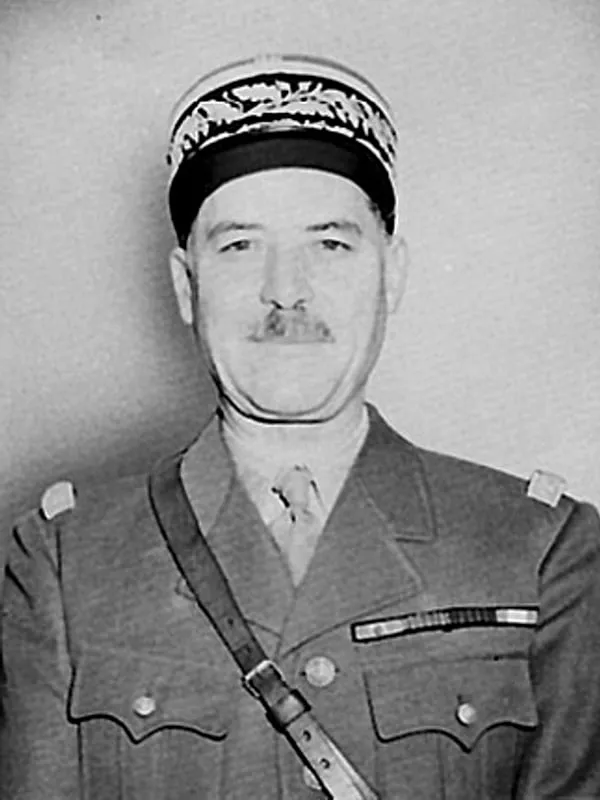
- Born:
- 16 December 1888, Bône, now Annaba (French Algeria)
- Died:
- 27 January 1967, Paris (France)
- Author:
- Łukasz
- Photo:
- autor nieznany, domena publiczna, Wikimedia Commons

Alphonse Juin was the only French general of the Second World War to receive the baton of a Marshal of France in his lifetime. The son of a gendarme from Algeria and a classmate of de Gaulle at Saint-Cyr, he travelled a longer and more winding road through this war than most of his colleagues: in 1940 he held out in the Lille pocket, spent a year in German captivity, then, as a trusted man of the Vichy government, commanded the army in North Africa, and when the Allies landed there in November 1942 he went over to their side. His greatest achievement came in the spring of 1944 in Italy: it was he who convinced the Allies that the Gustav Line could be outflanked through mountains the Germans barely defended, and it was his corps that opened the road to Rome. The same corps, however, left behind in the mountain villages of Lazio a memory of rape and murder that the Italians have not forgotten.
From Constantine to Saint-Cyr
Alphonse Pierre Juin was born on 16 December 1888 in Annaba, then Bône, in Algeria. His father, Victor Juin, became a gendarme after some fifteen years of military service; his maternal grandfather had followed a similar path. The family moved to Constantine, where the boy went to school and picked up Arabic in the street. A bursary took him through the local lycée, and in 1910, after the compulsory year of service in a Zouave regiment, he began his training at Saint-Cyr. His year was named the “Fez class”. It also included Charles de Gaulle, who to the end of his life addressed Juin with the familiar “tu”. Juin graduated in 1912 at the top of the list.
As a second lieutenant of Algerian riflemen (tirailleurs) he was posted to Morocco, where the French were just establishing their protectorate. When war broke out in 1914 he went to France with the Moroccan brigade and fought on the Marne in September; wounded in the left hand, he refused to be evacuated. In March 1915, in Champagne, a shell shattered his right arm. He never regained the use of it and for the rest of his career saluted with his left. After convalescence he spent six months as aide-de-camp to General Hubert Lyautey, the Resident-General in Morocco; in 1917 he led a company of Moroccan riflemen in the Nivelle Offensive, and at the end of the war he served with the French mission to the American army.
An officer of Africa
Juin spent almost the whole interwar period in North Africa and in military schools. After the École Supérieure de Guerre he worked on staffs in Tunisia and Morocco, and during the Rif War in the mid-1920s he led troops in the field and was promoted to major. On the staff at Fez he got to know Captain Jean de Lattre de Tassigny; in 1927 he was best man at his wedding. He also served as military secretary to General Charles Noguès, then one of the most important figures in French Morocco, taught tactics at the École de Guerre, and in 1935, as a colonel, took over the 3rd Zouave Regiment. Noguès, appointed Resident-General in Morocco, wanted him as his chief of staff in the event of war. On 26 December 1938 Juin was made a brigadier general.
1940: Gembloux, Lille and captivity
After the outbreak of war Juin helped send units of the Army of Africa to France, but he wanted a command at the front himself. On 4 December 1939 he took over the 15th Motorised Infantry Division, one of the better formations of the French army. When the Germans attacked on 10 May 1940, the division moved into Belgium and on 14–15 May at Gembloux stopped the tanks of Erich Hoepner (Belgian campaign). It then had to fall back together with the whole Allied left wing, cut off by the German breakthrough at Sedan. At the end of May the remnants of the division ended up in the Lille pocket, which tied down the Germans while the British and some of the French were sailing from Dunkirk. Some of his men got through to the port; the rest fought for as long as their ammunition lasted. Juin was taken prisoner.
He was held in an Oflag in the fortress of Königstein in Saxony, where he was promoted to major general. In June 1941 the Vichy government secured his release by putting him on a list of officers needed for the defence of French Africa. Juin was then regarded as a supporter of Marshal Pétain and an opponent of de Gaulle; there was even talk of making him minister of war, but he wanted to serve only in Africa. On 20 November 1941 he replaced Maxime Weygand as commander-in-chief of land forces in North Africa. In December he travelled to Berlin to meet Hermann Göring, who wanted consent for the Axis powers to use the Tunisian port of Bizerte; Juin pressed for weapons for the Army of Africa and promised nothing. At the same time a dispute over the defence of Tunisia ended with the recall of its commander, de Lattre, which soured the two generals’ friendship for years.
Algiers, November 1942
Juin knew nothing of the preparations for Operation Torch. On the night of 7–8 November 1942 conspirators from the local resistance surrounded his villa in Algiers, and the American consul Robert Murphy woke him with the news that the Americans would land within hours and a request that the army receive them as friends. Juin replied that the decision lay with his superior, Admiral François Darlan, who happened to be in the city, and summoned him to the villa (the Algiers putsch). In the morning the Mobile Guard freed both men, and Juin ordered the points seized by the volunteers to be retaken, but in the evening, with Darlan’s consent, he agreed a ceasefire with the Americans for Algiers alone. In Oran and Morocco the French went on fighting the Allies for another two days before Darlan issued an order for the whole of Africa (Darlan and the ceasefire).
The gravest charge later levelled at Juin concerned Tunisia. From 9 November the Germans were flying troops in to the airfield near Tunis, and the French units in the protectorate offered no resistance. Only on 11 November, after the Germans had marched into the unoccupied part of France, did Juin inform his subordinates that neutrality towards the Axis was over, and he issued the order to fight the Germans on 14 November. A commission set up in Algiers in 1943 held him responsible for the Axis forces entering Tunisia unopposed. Juin submitted a lengthy defence to de Gaulle and was told that he had nothing to fear about the past.
Tunisia
In the Tunisian campaign Juin commanded the French troops that took up positions on the ridges of central Tunisia between the British in the north and the Americans in the south. They had obsolete guns and almost no anti-tank weapons; at the end of January 1943 the German 21st Panzer Division drove them out of the Faïd Pass. The French commander was at first unwilling to serve under a Briton, but in the end he accepted General Kenneth Anderson’s authority over the whole front, and the French forces were concentrated in XIX Corps. Juin was promoted to full general. After the Axis surrender in May 1943 he rode into Tunis to cheering crowds and stood on the reviewing stand of the victory parade beside Eisenhower and Giraud.
Italy: the corps from the mountains
In the summer of 1943 Juin was tasked with forming the troops that were to fight in Italy. Because his French Expeditionary Corps was part of the American Fifth Army under General Mark Clark, who was junior to him in rank, Juin himself agreed to step down a grade, to corps general. The first divisions, the 2nd Moroccan and the 3rd Algerian, went into action in the winter. From 12 January 1944 the French attacked in the mountains north of Cassino and reached the main German line of defence, and at the end of the month they took the Belvedere massif. Juin was convinced that by pressing on through the mountains the monastery hill could be outflanked, but he was given no reserves and the attack stalled (Battle of Monte Cassino). When the bombers flattened the abbey in February, he is said to have remarked that nothing would be achieved that way.
After three failed battles General Harold Alexander prepared a great offensive by two armies, and Juin persuaded him to send his corps, enlarged to four divisions and three groups of Moroccan goumiers, through the Aurunci Mountains. The Germans considered them impassable for large forces and held them weakly. The attack began on the night of 11–12 May (fourth battle of Monte Cassino). After two days of hard fighting the 2nd Moroccan Infantry Division took Monte Maio, and columns of goumiers, supplied by pack mules, moved along the mountain ridges into the rear of the Germans in the Liri valley; on 15 May the French took Ausonia, and on 17 May Esperia. Clark later called it one of the most brilliant and daring advances of the whole war in Italy, and King George VI awarded Juin the Order of the Bath. On 5 June Juin rode beside Clark through liberated Rome. He believed that instead of racing for the city the Allies should have cut off and destroyed the retreating German armies, and the French command in Algiers did not back his wish to carry the Italian campaign further. At the beginning of July his soldiers entered Siena.
The breakthrough in the mountains has another side as well. In the wake of the corps’ advance, in May and June, in the mountain villages of southern Lazio, and in the summer in Tuscany too, soldiers of the colonial units, mainly goumiers, committed mass rape, murder and looting. The Italians called these crimes the marocchinate. The number of victims is disputed: estimates range from several hundred to several thousand people. The French command reacted late, and the severe punishments introduced later did not stop all the crimes. In a letter to Clark of 22 July Juin dismissed the Italian protests as a campaign designed to discredit the French army. A story that spread later, that before the attack he had promised his men fifty hours of impunity, finds no confirmation in the documents, but a commander’s responsibility for the men he led remains the darkest stain on his record.
Chief of staff of liberated France
In the summer of 1944 Juin’s divisions were withdrawn from Italy for Operation Dragoon, where de Lattre led them, while Juin himself became Chief of the National Defence Staff in de Gaulle’s government. He helped persuade Eisenhower to let the French division of Philippe Leclerc liberate Paris, entered the capital with de Gaulle on 25 August, and the next day walked in the parade on the Champs-Élysées. He dealt with absorbing resistance units into the regular army. In January 1945, when the American command wanted to pull its troops out of northern Alsace in the face of Operation Nordwind, he argued for holding Strasbourg in a heated exchange with Eisenhower’s chief of staff, General Walter Bedell Smith (the dispute over Strasbourg). The end of the war in Europe found him in the United States, where he represented France at the San Francisco conference that founded the United Nations.
Marshal of France
Juin remained chief of staff until 1947. He then spent four years as Resident-General in Morocco, where he fought the independence movement hard and clashed bitterly with Sultan Mohammed V. From 1953 to 1956 he commanded NATO forces in Central Europe. On 7 May 1952 he was made a Marshal of France, and on 20 November that year a member of the Académie française. As a man born in Algeria he could not accept de Gaulle’s decision to grant it independence. He did not support the generals’ putsch of 1961, but for his open opposition to the Algerian policy his former Saint-Cyr classmate removed him from all his functions and stripped him of a marshal’s privileges. He died on 27 January 1967 in Paris, at the Val-de-Grâce hospital, and was buried at Les Invalides (PL).
For the French, Juin is above all the “victor of the Garigliano”, the general who gave the French army its first great victory over the Germans since 1940 and proved to its allies that it deserved a seat at the table. Allied commanders, from Clark to Alexander, rated him one of the best tacticians of the Italian campaign. Historians also point out that until 1942 he served Vichy loyally, and that his conduct in the first days after the Allied landings made it easier for the Germans to enter Tunisia. In Italy his name is still linked above all with the marocchinate.
Sources
Commanded in battles
(02)Mentioned in battles
(03)Often appears with
People who appear in the same events.
On the timeline
(18)1940
1942
November
- 08
- Key eventThe landings in North AfricaOn 8 November 1942 more than 70,000 American and British troops landed in Morocco and Algeria. The Vichy French resisted at Casablanca and Oran.
- The Algiers putschOn the night of 7/8 November 1942 some 400 underground volunteers seized Algiers for several hours and detained General Juin and Admiral Darlan.