Germany
Erich Hoepner
Commander of XVI Army Corps (1938–1941), the 4th Panzer Group and 4th Panzer Army (1941–1942); member of the 20 July 1944 plot
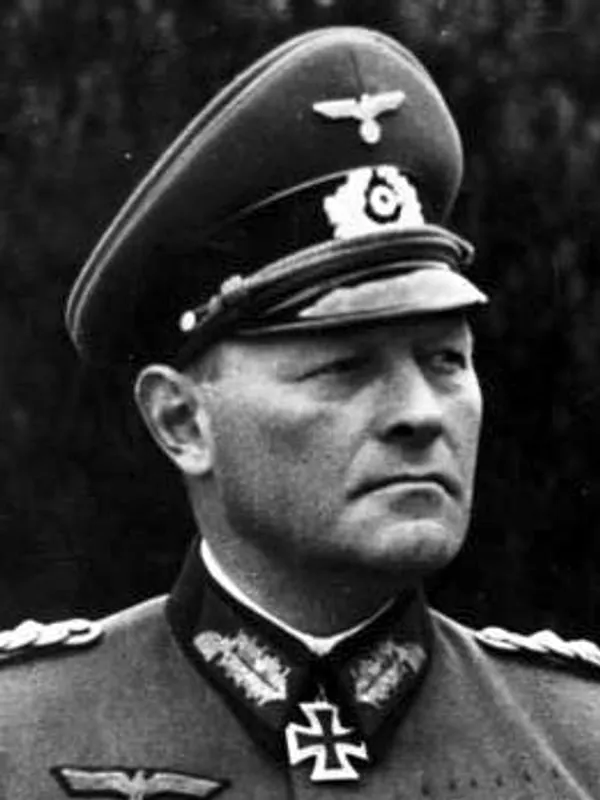
- Born:
- 14 September 1886, Frankfurt an der Oder, Brandenburg (German Empire)
- Died:
- 8 August 1944, Berlin-Plötzensee (Third Reich)
- Author:
- Łukasz
- Photo:
- autor nieznany, CC BY-SA 3.0 DE, Wikimedia Commons

Erich Hoepner was a German colonel general, one of the creators of Germany’s armoured force, and at the same time a figure who remains disputed to this day. In 1939 his panzer corps drove from the border to the outskirts of Warsaw in a week; in 1941 his 4th Panzer Group advanced on Leningrad and then on Moscow, where it came closer than any other German force. In January 1942, against Hitler’s ban, he pulled back troops threatened with encirclement and was thrown out of the army in disgrace. Two and a half years later, as a participant in the 20 July plot, he died on the gallows at Plötzensee. In the spring of 1941 the same man had, on his own initiative, prepared his soldiers for a war of annihilation against “Jewish Bolshevism”.
Cavalryman and staff officer
Erich Kurt Richard Hoepner was born on 14 September 1886 in Frankfurt an der Oder, the son of the army doctor Kurt Hoepner and Elisabeth, née Kienast. He spent his childhood in Charlottenburg outside Berlin. After leaving school in 1905 he joined the 13th Dragoon Regiment at Metz as an officer cadet, and in 1906 he was commissioned as a second lieutenant. In 1910 he married Irma Gebauer; they had two children. Before the war he studied at the War Academy in Berlin.
In the First World War he served on the Western Front as a company commander and as a staff officer of several corps and armies, and in the spring of 1918 he fought in the German spring offensive with the 105th Infantry Division. He ended the war as a cavalry captain.
The Reichswehr and the first conspiracy
In 1920 Hoepner was taken into the Reichswehr. He commanded a squadron, worked in the cavalry inspectorate and on staffs, and in 1933, as a colonel, became chief of staff of the military district in Königsberg. In 1935 he was transferred to the army general staff in Berlin, where he grew close to its chief, General Ludwig Beck. According to German biographies, he was already criticising among fellow officers the influence of Nazi ideology on the army. In 1936 he became a major general, and in 1937 he took over the 1st Light Division in Wuppertal, one of the Wehrmacht’s first motorised divisions; from July 1938 the young Claus von Stauffenberg served on its staff.
In the autumn of 1938, during the Sudeten crisis, Hoepner belonged to the circle of officers around General Franz Halder who planned to overthrow Hitler if he started a war with Czechoslovakia. He agreed to place his division at the conspirators’ disposal. The Munich Agreement took away their pretext, and the coup never happened. Hoepner was promoted to lieutenant general and in the autumn succeeded Heinz Guderian at the head of XVI Army Corps in Berlin, the first German panzer corps; his chief of staff was Friedrich Paulus. In March 1939 he led it into the Czech lands, and in April he became a general of cavalry.
Poland, 1939
In the September campaign XVI Corps, with the 1st and 4th Panzer Divisions and two infantry divisions, was the main battering ram of General Walther von Reichenau’s 10th Army. According to German studies, as late as August Hoepner promised his soldiers the “merciless destruction of the enemy”. His tanks covered some 230 kilometres from the border and on 8 September stood before Warsaw, where Georg-Hans Reinhardt’s 4th Panzer Division was thrown back from the barricades in Ochota. A few days later the corps was turned round towards the Bzura: from the east it blocked the road to the capital for the “Poznań” and “Pomorze” Armies, fought hard battles around Sochaczew and took part in destroying the Polish grouping. On 27 October 1939 Hoepner received the Knight’s Cross.
Belgium, France and the “Totenkopf” division
In May 1940 XVI Corps, with the 3rd and 4th Panzer Divisions, advanced across central Belgium as part of the 6th Army. In the Belgian campaign, on 12 and 13 May, his tanks clashed at Hannut with General René Prioux’s French cavalry corps, in one of the first great tank battles of the war. At Gembloux Hoepner tried to break through the positions of the French 1st Army on the march and was repulsed, but the French, threatened with encirclement by the breakthrough at Sedan, had to fall back anyway, and Brussels fell on 17 May.
On 22 May Theodor Eicke’s SS division “Totenkopf” was assigned to his corps. Hoepner had already issued an order that soldiers who mistreated prisoners were to be court-martialled. On 27 May Eicke’s SS men murdered almost a hundred British prisoners at Le Paradis. Hoepner demanded an investigation and Eicke’s removal if SS guilt was confirmed, but the affair was hushed up. From then on he treated the “Totenkopf” commander with contempt, calling him a butcher. In June the corps advanced south through Burgundy, and towards the end of the Italian invasion of France its columns were sent towards Chambéry and Grenoble, into the rear of the French Alpine forts. On 19 July 1940 Hoepner was promoted to colonel general.
The order of 2 May 1941
Before the attack on the USSR Hoepner took over the 4th Panzer Group, with Reinhardt’s XXXXI Corps and Erich von Manstein’s LVI Corps, in Field Marshal Wilhelm von Leeb’s Army Group North. On 2 May 1941, before the Wehrmacht high command had even issued the so-called jurisdiction decree, he gave his troops an instruction that called the war against the USSR the old struggle of the Germanic peoples against the Slavs and a defence against “Jewish Bolshevism”, and set as its aim the smashing of present-day Russia, to be pursued with “unprecedented severity”. The German historian Jürgen Förster regards this document as an independent translation of Hitler’s intentions into the language of an order.
Practice did not lag behind the words. His troops carried out the Commissar Order: according to the reports, by mid-July 1941 more than 170 political commissars had been shot in the 4th Panzer Group, and according to German studies Hoepner ordered civilian commissars to be killed as well. The commander of Einsatzgruppe A, Franz Walter Stahlecker, praised in his reports the close cooperation of the panzer group, which helped move his commandos up behind the front, and the Wehrmacht did not intervene in the Kaunas pogrom. The German Resistance Memorial Center points out that in August 1941 Hoepner demanded the use of poison gas against partisans, and on 12 November ordered that everyone suspected of partisan activity be shot rather than sent to prisoner-of-war camps.
Leningrad and Moscow
In Operation Barbarossa Hoepner’s group set out from East Prussia across Lithuania and Latvia. At the end of June Manstein seized the bridge over the Daugava at Daugavpils, and at the beginning of July the tanks advanced through Latvia to Ostrov and Pskov. Beyond Pskov Hoepner split his corps and did not wait for the infantry, which backfired at Soltsy, where in mid-July the Soviet 11th Army struck Manstein’s exposed corps. The drive on Leningrad began from the bridgeheads on the Luga on 8 August, and at the beginning of September Hoepner’s panzer divisions stood on the approaches to the city. They did not have time to take it: from mid-September Hitler was taking them away from Leningrad for Moscow.
In Operation Typhoon the 4th Panzer Group, the strongest of them all, attacked as part of Field Marshal Günther von Kluge’s 4th Army along the Warsaw highway. On 7 October its 10th Panzer Division entered Vyazma and closed the Vyazma pocket from the south. From then on a conflict grew between Hoepner and Kluge, who held back the tanks so as first to destroy the encircled troops. The autumn mud and fuel shortages halted the advance for several weeks. In the November offensive Hoepner’s group, alongside Reinhardt’s 3rd Panzer Group, pushed Konstantin Rokossovsky’s Soviet 16th Army back towards Moscow. In early December its leading units reached Krasnaya Polyana, and a patrol, according to German accounts, got to Khimki, some twenty-odd kilometres from the Kremlin. As late as 2 December Hoepner was arguing that encircling Moscow was possible, but the very next day he warned Kluge that further attacks would bleed his divisions white. On 5 December the attack was called off. In a letter home Hoepner blamed Kluge and wrote that he alone had come within thirty kilometres of the city.
Dismissal
When the Soviet counter-offensive at Moscow began, Hoepner, like Guderian, wanted to pull his troops back to shorter lines. Hitler forbade any retreat, and a few days later took over as commander-in-chief of the army. In early January 1942 one of the corps of the 4th Panzer Army, as Hoepner’s group had been renamed at the turn of the year, was threatened with encirclement. Hoepner asked Kluge, since December commander of Army Group Centre, for permission to withdraw, and when it did not come, he gave the order himself on 8 January. Kluge reported this to Hitler at once. That same day Hitler threw Hoepner out of the Wehrmacht for “cowardice and disobedience”, without a trial, depriving him of the right to his uniform, decorations and pension. According to some biographers, Hoepner sued the state and won back his pension rights. The affair had repercussions: in April 1942, at the last session of the Reichstag, Hitler had himself granted the right to remove any official or officer without any proceedings at all.
Conspirator
Removed from the army, Hoepner lived in Berlin and from 1943 with his sister in Brandenburg. He renewed his contacts with Beck and General Friedrich Olbricht, and later with Stauffenberg, and was let into the plans for the assassination. Under the Operation Valkyrie plan he was to replace General Friedrich Fromm as commander of the Replacement Army, that is, commander-in-chief of the forces at home. On 20 July 1944 he was in the Bendlerblock, the conspirators’ headquarters on Bendlerstraße. Once it became clear that Hitler had survived, the coup collapsed within hours, and in the night before 21 July Hoepner was arrested.
He refused to commit suicide, as he was urged to do, and demanded a trial. On 7 and 8 August 1944 he stood before the People’s Court together with Field Marshal Erwin von Witzleben and six other defendants. He was brought into the courtroom in clothes too big for him, and the presiding judge, Roland Freisler, heaped insults on him. On 8 August all of them were sentenced to death and hanged the same day in Plötzensee prison. Under the principle of collective punishment his wife, daughter, son, brother and sister were arrested; his wife and daughter were sent to Ravensbrück concentration camp.
Memory
After the war Hoepner, like the other executed conspirators, was recognised in the Federal Republic as a hero of the resistance. In 1956 a school in Berlin was named after him. Over time, as historians’ research brought his 1941 orders and his troops’ cooperation with the Einsatzgruppen to light, this image began to crumble: in 2008 the Berlin school dropped his name. Hoepner remains an example of a general who in 1938 and in 1944 was ready to act against Hitler, and in 1941 waged Hitler’s war of annihilation in the east with conviction.
Sources
Mentioned in battles
(08)Often appears with
People who appear in the same events.
On the timeline
(17)1940
1941
June
- 22
- Key eventGermany invades the Soviet UnionAt dawn on 22 June 1941 Germany and its allies attacked the USSR. Operation Barbarossa broke the pact of 1939 and opened the Eastern Front.
- The June Uprising in LithuaniaOn 22 June 1941 Lithuanians rose against the Soviets and next day proclaimed a restored state in Kaunas. Germany did not recognise it; a pogrom followed.