Soviet Union
Fyodor Tolbukhin
Chief of staff of the Transcaucasian, Caucasian and Crimean Fronts (1941–1942), commander of the 57th Army (1942–1943), Southern and 4th Ukrainian Fronts (1943–1944) and 3rd Ukrainian Front (1944–1945), Marshal of the Soviet Union (from 1944)
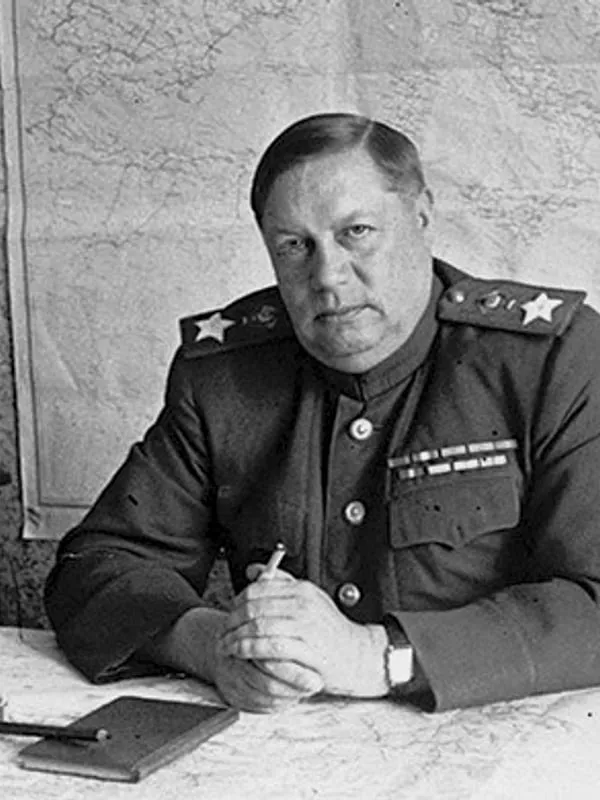
- Born:
- 16 June 1894, Androniki, Yaroslavl Governorate (Russia; then the Russian Empire)
- Died:
- 17 October 1949, Moscow (Soviet Union)
- Author:
- Łukasz
- Photo:
- autor nieznany, CC BY 4.0, Wikimedia Commons

Fyodor Tolbukhin was one of the commanders who in 1943–1945 led the Red Army from southern Russia all the way to Austria. A bookkeeper by training and an officer of the tsarist army in the First World War, he spent twenty years in the Red Army mainly as a staff officer and joined the party only in 1938. He became a front commander at almost 49, but his troops then retook the Donbas and the Crimea, took part in the destruction of the Germans and Romanians at Jassy and Kishinev, occupied Bulgaria, took Belgrade together with Tito’s partisans, closed the encirclement of Budapest from the south, beat off the Wehrmacht’s last great offensive at Lake Balaton and entered Vienna. He had a reputation as a calm and meticulous commander who cared about his soldiers’ lives more than many of his colleagues.
Bookkeeper and staff captain
He was born on 16 June 1894 (a day earlier according to some sources) in the village of Androniki in the Yaroslavl Governorate, into a peasant family. After his father’s death he went to relatives in St Petersburg, where in 1912 he finished a commercial school and worked as a bookkeeper. In 1914 he was called up. He served at first as a motorcycle rider, in 1915 he graduated from the ensigns’ school at Oranienbaum, and on the Southwestern Front he commanded a company and then a battalion. He received the Orders of St Anne and St Stanislaus. After the February Revolution the soldiers elected him chairman of the regimental committee. He ended the war as a staff captain.
Staff officer
In August 1918 he volunteered for the Red Army, one of the many former tsarist officers the Bolsheviks needed to build their army. In the Civil War he was a staff officer of the 56th Rifle Division on the Western Front; in 1921 he took part in crushing the Kronstadt rising and then in the fighting against Finnish volunteers in Karelia. For the next dozen or so years he was chief of staff of divisions and corps; in 1934 he graduated from the Frunze Military Academy, and in 1937 he took over the 72nd Rifle Division in Ukraine. His background in the tsarist officer corps and his lack of a party card made him an easy target during the Great Purge, but he survived it. In July 1938 he became chief of staff of the Transcaucasian Military District in Tbilisi, and the same year he joined the party. In June 1940 he was made a major general.
Iran and Kerch
The war with Germany found him at his post in Tbilisi. In August 1941 the district was turned into the Transcaucasian Front, and its staff under Tolbukhin’s direction prepared the entry of Soviet troops into northern Iran as part of the joint invasion with the British. At the end of 1941, now chief of staff of the Caucasian Front, he drew up the plan for the landing on the Kerch Peninsula, put ashore at the end of December at Kerch and Feodosia.
In January 1942 he became chief of staff of the new Crimean Front. Its command was to liberate the whole Crimea, but one attack after another from the Kerch bridgehead collapsed with heavy losses. Stalin’s representative at the front, Lev Mekhlis, put the blame on the chief of staff, and on 10 March 1942 Tolbukhin was recalled. Paradoxically, this saved his career: two months later the Crimean Front suffered a disaster from which only part of its troops were evacuated across the Kerch Strait, and its commanders were demoted.
Stalingrad
From July 1942 Tolbukhin commanded the 57th Army, which was defending south of Stalingrad. During the Battle of Stalingrad his army held a line in the steppe and in the southern suburbs of the city, and Andrey Yeryomenko thought highly of its organisation. On 20 November 1942 the 57th Army attacked as part of Operation Uranus and became part of the ring around the 6th Army. In January 1943 Tolbukhin was made a lieutenant general and received the Order of Suvorov, 1st class, and in February he briefly commanded the 68th Army on the Northwestern Front.
The Mius, Melitopol and the Crimea
On 13 March 1943 he took over the Southern Front, which stood on the Mius river. In July, while the Battle of Kursk was being fought, his troops took a bridgehead across the Mius but had to withdraw from it in the face of a German counter-attack. They did, however, tie down German reserves that were missing at Kursk. In a second attack, in August, the front broke through the defences on the Mius, took Taganrog on 30 August and then advanced through the Donbas to the Molochnaya river, part of the German defence line on the Dnieper. In September Tolbukhin became a general of the army. The heavy fighting for the fortifications on the Molochnaya ended in October with the capture of Melitopol. On 20 October the front was renamed the 4th Ukrainian. Its troops reached the lower Dnieper and Perekop, cutting off the German 17th Army in the Crimea.
In the spring of 1944 the turn came for the Crimea itself. From 8 April the 4th Ukrainian Front, accompanied by Aleksandr Vasilevsky as the representative of the High Command, attacked across the Perekop Isthmus and from bridgeheads on the Sivash, while the Separate Coastal Army advanced from the east. The Crimean offensive lasted five weeks. On 9 May Tolbukhin’s troops entered Sevastopol, and the remnants of the German-Romanian 17th Army, which Adolf Hitler had ordered to hold out to the end, were defeated on the Chersonese.
Romania and Bulgaria
In May 1944 Tolbukhin took over the 3rd Ukrainian Front on the lower Dniester. On 20 August his troops attacked from the bridgehead south of Bender, together with Rodion Malinovsky’s 2nd Ukrainian Front, opening the Jassy–Kishinev offensive. The two fronts encircled the German 6th Army, and Romania went over to the Allied side. On 12 September 1944, two days after Malinovsky, Tolbukhin was made a Marshal of the Soviet Union.
On 5 September the Soviet Union declared war on Bulgaria, which was not fighting it but was Germany’s ally. On 8 September troops of the 3rd Ukrainian Front crossed the border in the Dobruja without meeting resistance, and the next day in Sofia power was seized by the Fatherland Front, with communist participation. Tolbukhin became head of the Allied Control Commission in Bulgaria, which in practice meant Soviet supervision of the country at a time when the communists were settling accounts with the old elite.
Belgrade, Budapest, Balaton
In October 1944 the 3rd Ukrainian Front entered Yugoslavia. In the Belgrade offensive its 57th Army and a mechanised corps fought alongside Josip Broz Tito’s troops, and on 20 October Belgrade was liberated. Under Tito’s agreement with Stalin, the main Soviet forces did not stay in Yugoslavia but turned north. In November the front crossed the Danube in southern Hungary, reached Lake Balaton and on 26 December, together with Malinovsky’s troops, closed the ring around Budapest. In January 1945 it was on his sector that successive German attempts to relieve the besieged city fell; they came within some ten to several dozen kilometres of the city but did not break the ring.
On 6 March 1945 the Germans opened their last great offensive of the war at Lake Balaton, Operation Spring Awakening, in which the 6th SS Panzer Army played the main part. When the situation was at its worst, Tolbukhin asked for permission to use the 9th Guards Army standing in reserve, but the High Command refused: that army was to remain intact for the advance on Vienna. His troops defended themselves on successive prepared lines, bled the German panzer divisions white and after ten days stopped the attack. On 16 March the front went over to the Vienna offensive, entered Austria, and on 13 April, after street fighting, took Vienna. On Stalin’s instructions Tolbukhin agreed that Karl Renner should form a provisional Austrian government, which marked the beginning of the rebirth of an independent republic. On 26 April 1945 he received the Order of Victory.
After the war and assessment
After the war he was commander-in-chief of the Southern Group of Forces in Romania and Bulgaria, and from January 1947 commander of the Transcaucasian Military District. He suffered badly from diabetes. He died in Moscow on 17 October 1949 at the age of 55, and the urn with his ashes was placed in the Kremlin Wall. He was made a Hero of the Soviet Union only posthumously, in 1965. In 1949 the Bulgarian town of Dobrich was renamed Tolbukhin; the name lasted until 1990.
Tolbukhin is one of the less well-known marshals of the war: he left no memoirs, died early and took no part in the post-war quarrels over credit. Historians, however, rate him highly. He was a methodical commander who prepared his operations carefully, could defend better than many Soviet generals, as he showed at Balaton, and did not squander his soldiers’ lives. For Bulgarians and Yugoslavs he was for decades a symbol of liberation, and from 1990, as they broke with their communist past, also a symbol of the Soviet domination to which this war opened the way.
Sources
Commanded in battles
(07)- 26 August – 23 December 1943Battle of the DnieperEastern Front
- 8 April – 12 May 1944Crimean offensive (1944)Eastern Front
- 20–29 August 1944Jassy–Kishinev offensiveEastern Front
- 28 September – 20 October 1944Belgrade offensiveBalkans
- 29 December 1944 – 13 February 1945Siege of BudapestEastern Front
- 6–16 March 1945Operation FrühlingserwachenEastern Front
- 16 March – 15 April 1945The Vienna offensiveEastern Front
Mentioned in battles
(02)Often appears with
People who appear in the same events.
On the timeline
(22)1941
1942
1943
1944
1945
February
March
- 29
- The Deutsch Schützen massacreOn 29 March 1945 at Deutsch Schützen in Burgenland the SS shot at least 57 Hungarian Jews – forced labourers building fortifications.
- The Red Army enters AustriaOn 29 March 1945 tanks of the 3rd Ukrainian Front crossed Austria's old border at Klostermarienberg in Burgenland. The road to Vienna lay open.