Germany
Kurt Zeitzler
Chief of staff of XXII Corps, Panzer Group Kleist and the 1st Panzer Army (1939–1942), of Army Group D (1942), Chief of the Army General Staff (1942–1944)
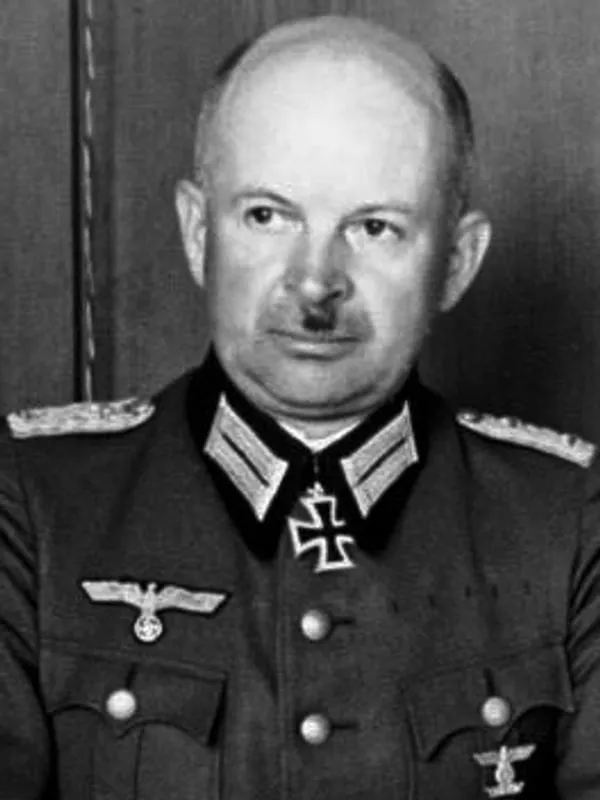
- Born:
- 9 June 1895, Goßmar near Luckau, Brandenburg (German Empire)
- Died:
- 25 September 1963, Hohenaschau (West Germany)
- Author:
- Natalia
- Photo:
- Neubauer, CC BY-SA 3.0 DE, Wikimedia Commons

Kurt Zeitzler was Chief of the General Staff of the German Army in its worst period of the war: from the defeat at Stalingrad, through the failed offensive at Kursk, to the destruction of Army Group Centre in the summer of 1944. Adolf Hitler chose him in September 1942 because he wanted an energetic executor, not a critic such as his predecessor Franz Halder had become. Zeitzler, an outstanding organiser of the movement and supply of large armoured formations, soon began to argue with Hitler himself. Several times he wrung from him a retreat that saved whole armies; more often he lost, and in July 1944 he simply stopped coming to work. He is also one of the fathers of Operation Citadel, the last great German offensive in the east.
A pastor’s son in uniform
Kurt Zeitzler was born on 9 June 1895 in Goßmar near Luckau in Lower Lusatia, into a Protestant pastor’s family. After leaving school, in March 1914, he joined the Thuringian Infantry Regiment No. 72 in Torgau as an officer cadet and a few months later went to war with it. In December 1914 he became a second lieutenant, commanded among other things a company of pioneers, was wounded, and ended the war as a lieutenant and regimental adjutant.
Taken into the 100,000-man Reichswehr, he served in an infantry regiment in Paderborn, and from 1926 underwent informal staff training in divisional headquarters. In Dresden his superior at the time was the chief of staff of the 4th Division, Ludwig Beck, later Chief of the General Staff. He became a captain in 1928, worked on the staff of the 3rd Division in Berlin from 1929 to 1932, and in 1934 went to the Reichswehr ministry. As a lieutenant colonel he worked in the national defence department of the staff of the Armed Forces High Command, at the very heart of war planning. In April 1939 he took over the 60th Infantry Regiment in Lüdenscheid, and on 1 June 1939 he was made colonel.
Kleist’s chief of staff
At the end of August 1939 Zeitzler became chief of staff of the XXII Motorised Corps of General Ewald von Kleist, which in the September campaign fought on the right wing of the 14th Army, from the direction of Slovakia and Lesser Poland. In the spring of 1940 the corps headquarters was renamed Panzer Group Kleist, and it was Zeitzler who organised its march through the Ardennes in the French campaign. Pushing several armoured and motorised divisions along narrow forest roads to the Meuse was one of the hardest logistical tasks of the war, and it succeeded. From then on Kleist and Zeitzler were a well-matched pair. In April 1941 the 1st Panzer Group took part in the invasion of Yugoslavia, for which Zeitzler received the Knight’s Cross on 18 May.
In Operation Barbarossa the 1st Panzer Group (from October the 1st Panzer Army) was the battering ram of Army Group South. First it encircled Soviet forces at Uman, then turned north and closed the pocket from the south in the Battle of Kiev, and finally reached the Sea of Azov and Rostov. Throughout, Zeitzler made sure that units which covered hundreds of kilometres in a few weeks, in constantly changing directions, had fuel and ammunition. Kleist later said that in throwing armies about like this the biggest problem was precisely supply. In the winter of 1941/1942 Zeitzler improvised ways of surviving the frost and told Hitler about it at a separate meeting. The dictator was delighted, and at headquarters Zeitzler had a friend in Hitler’s chief adjutant Rudolf Schmundt.
On 1 February 1942 Zeitzler became a major general, and in April chief of staff of Army Group D, the command of Field Marshal Gerd von Rundstedt in the west. He was to strengthen the defence of the French coast. For his lively temperament and stocky build he was nicknamed there “Kugelblitz”, ball lightning. On 19 August 1942 his staff dealt with the Allied landing at Dieppe.
Chief of the General Staff
On 24 September 1942 Hitler dismissed Halder, with whom he had been quarrelling over the conduct of Operation Blue, and appointed Zeitzler in his place, promoting him straight to General of Infantry and skipping the rank of lieutenant general. He picked him over many officers senior in rank and service. According to Albert Speer, Hitler wanted someone beside him who would not brood over his orders but carry them out with zeal. His authority was in any case smaller than that of his predecessors: since December 1941 Hitler himself had commanded the army, and Zeitzler’s staff was in practice responsible for the Eastern Front, while the other theatres came under the staff of Alfred Jodl at the OKW.
The first great test was Stalingrad. Zeitzler warned of the weakness of the flanks on the Don, and when Operation Uranus began on 19 November he asked Hitler several times for permission to withdraw, and then for the 6th Army to break out, in line with the requests of its commander Friedrich Paulus. According to his post-war account, when Hermann Göring assured Hitler that the Luftwaffe would supply the encircled army by air, Zeitzler told him it was impossible. Hitler decided otherwise. The chief of staff sent an officer with a radio set into the pocket so as to know the army’s real situation every day, and cut his own and his officers’ food to the rations of the soldiers in Stalingrad. He lost more than ten kilograms before Hitler ordered him to stop. In December Erich von Manstein attempted a relief in Operation Winter Storm, but Hitler still would not allow the 6th Army to leave the city.
Zeitzler did, however, win another success. On the evening of 27 December 1942, as he himself told it, he warned Hitler that without an immediate retreat from the Caucasus he would have “a second Stalingrad”, and obtained his consent, which he passed on at once by telephone before the dictator could change his mind. The retreat from the Caucasus saved Army Group A. In early 1943 he also secured the withdrawal of troops from the exposed salients at Rzhev and Demyansk, which shortened the front and gave the Germans reserves.
Citadel and the Crimea
In the spring of 1943 Zeitzler drew up the first plans for a strike at the Kursk salient and urged it on Hitler despite the objections of some commanders. When Hitler, waiting for new tanks, postponed the date several times, Zeitzler, like Günther von Kluge, still wanted the offensive, while Heinz Guderian warned against it. The Battle of Kursk ended in July in a strategic defeat. Zeitzler later refused to accept responsibility for the outcome, arguing that the delay, which he had opposed, had robbed the operation of its chances.
On 30 January 1944, on the same day as Jodl, he was made colonel general, at the time the youngest in the army. His relations with Hitler, however, were deteriorating. In the spring of 1944 he argued for evacuating the 17th Army, cut off in the Crimea, and when Hitler refused and the army suffered heavy losses in the Crimean operation, the dictator blamed the defeat on him. Zeitzler began to ask to be relieved.
Escape into illness
The destruction of Army Group Centre in Operation Bagration in June 1944 was the last straw. Zeitzler demanded a swift withdrawal of Army Group North so that it would not be cut off, and according to some accounts told Hitler outright that the war was militarily lost. Hitler flew into a rage. At the turn of June and July 1944 (sources give 30 June or 1 July) Zeitzler reported sick and never appeared at headquarters again. Hitler never spoke to him again. The duties of chief of staff were taken over by the head of the operations department, Adolf Heusinger (PL), and when he was wounded in the 20 July plot, by Guderian.
Zeitzler took no part in the conspiracy, although his adjutant Günther Smend tried to draw him into it. Because several of his subordinates were implicated in the attempt, he wrote Hitler a letter assuring him of his loyalty. It did no good: in August he was moved to the reserve, and on 31 January 1945 he was dismissed from the army and forbidden to wear uniform. Intercession by Rundstedt and Speer did not help.
After the war
After the surrender Zeitzler became a British prisoner of war and was released in February 1947. He appeared as a defence witness at the Nuremberg trials, and then worked with the historical division of the US Army, for which German generals wrote accounts of the war in the east. He lived in Hamburg, then in Hohenaschau in Upper Bavaria, where he died of lung cancer on 25 September 1963.
Historians judge Zeitzler a capable and courageous staff officer, a master at directing the movement of large armoured formations. As Chief of the General Staff, however, he was in an impossible position: Hitler chose him as an obedient executor, and once Zeitzler began telling him the truth about the situation at the front, he stopped listening to him. His accounts of his quarrels with the dictator, written after the war, are the main source on many decisions of 1942–1944, but they show him in a favourable light and must be read with care, all the more so since he himself did much to bring about the decision to attack at Kursk.
Sources
Mentioned in battles
(04)Often appears with
People who appear in the same events.