Germany
Günther von Kluge
Commander of the Fourth Army (1939–1941) and Army Group Centre (1941–1943), Commander-in-Chief West and commander of Army Group B (July–August 1944)
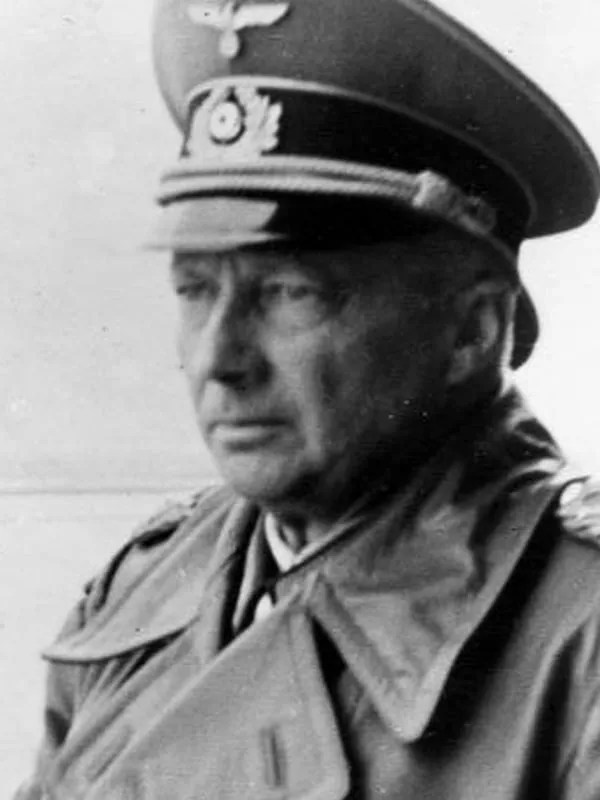
- Born:
- 30 October 1882, Poznań (German Empire, now Poland)
- Died:
- 19 August 1944, Near Valmy (France)
- Author:
- Natalia
- Photo:
- Scheck, CC BY-SA 3.0 DE, Wikimedia Commons

Günther von Kluge was one of the Wehrmacht’s ablest operational commanders and one of the most irresolute men in its high command. In September 1939 his Fourth Army cut across Pomerania, in May 1940 it broke through the Ardennes to the English Channel, and in 1941 it marched on Moscow. For almost two years he commanded Army Group Centre, on whose staff the core of the military conspiracy against Hitler was based; Kluge knew about it and talked to the conspirators, but never joined them. In the summer of 1944 he commanded the front in Normandy, and after the defeat at Falaise, dismissed and suspected of treason, he poisoned himself on his way back to Germany.
A general’s son from Poznań
Günther Adolf Ferdinand Kluge was born on 30 October 1882 in Poznań, then a Prussian garrison town, the son of the officer Max Kluge, who rose to the rank of lieutenant general. In 1913 his father was granted hereditary nobility, and from then on the family bore the name “von Kluge”. At cadet school his classmates nicknamed Günther “clever Hans” (der kluge Hans), after a then famous “counting” horse; this is the origin of the first name Hans, which he never had but which still appears in many books.
In 1901 he was commissioned as a second lieutenant in the field artillery. After graduating from the war academy he joined the Great General Staff in 1910 and served throughout the First World War as a staff officer on the Western Front, among other places in Flanders. In the autumn of 1918, while reconnoitring the front line near Verdun, he was seriously wounded. In 1907 he had married Mathilde von Briesen; they had a son and two daughters, and from 1930 they lived on his wife’s estate at Böhne in Brandenburg.
Reichswehr and Wehrmacht
Kluge remained in the 100,000-strong army of the Weimar Republic and was promoted quickly. In 1930, as a colonel, he commanded an artillery regiment in Schwerin; in 1933 he was a major general and inspector of signal troops; in 1934 he took over a division in Münster and in 1935 the VI Corps built up from it. In 1936 he was promoted to general of artillery, and at the end of 1938 he took over the group command in Hanover, which in wartime became the headquarters of the Fourth Army. In private he criticised Hitler’s reckless policy, but he was pleased by the rebuilding of the army and did not question the goals that the regime set for it.
Pomerania, the Ardennes, Dunkirk
In the September Campaign Kluge’s Fourth Army, part of Fedor von Bock’s Army Group North, attacked from Western Pomerania into the Polish Corridor. The Polish divisions of the Pomorze Army could not stop it on the Brda, and on 3 September the Fourth Army linked up with the troops advancing from East Prussia. Then Heinz Guderian’s panzer corps, previously under his command, moved south through East Prussia and captured Brest. For the campaign Kluge received the Knight’s Cross on 30 September and promotion to colonel general.
In May 1940 the Fourth Army attacked through the Belgian Ardennes as part of Gerd von Rundstedt’s Army Group A. Its XV Corps, with Erwin Rommel’s 7th Panzer Division, crossed the Meuse at Dinant on 13 May and shattered the French Ninth Army. On 24 May, after a conference with Hitler and Rundstedt, Kluge passed on to his panzer divisions the halt order a dozen or so kilometres from Dunkirk, which gave the British time to organise the evacuation. In the second phase of the campaign in France his army broke through the front on the Somme, reached the Seine and took the Atlantic ports; at Saint-Valery-en-Caux the Scottish 51st Division surrendered to it. On 19 July 1940 Kluge became one of twelve new field marshals.
On Moscow
In Operation Barbarossa the Fourth Army formed part of Army Group Centre. After the pockets at Białystok and Minsk had been closed, the army high command placed both panzer groups, Guderian’s and Hermann Hoth’s, under Kluge for a few weeks. The cooperation went badly: Guderian and Kluge heartily loathed each other. According to historians’ findings, in the first days of the war Kluge issued an order that women fighting in Red Army uniform were to be shot, which was soon withdrawn, and in July some 100,000 prisoners of war and 40,000 civilians were crammed under the open sky in a camp near Minsk that came under his army. In September the same Kluge warned his soldiers that looting and unauthorised requisitioning, which were wrecking discipline, would be punished.
During Operation Typhoon Erich Hoepner’s 4th Panzer Group was placed under him, and in October 1941 it closed the pocket at Vyazma. In the November attack on Moscow Kluge long delayed committing the weak southern wing of his army, which Hoepner and Guderian later blamed for the failure; modern historians such as David Stahel point out that the Germans simply no longer had the strength to take Moscow.
Army Group Centre
During the Soviet counter-offensive, on 18–19 December 1941, Kluge replaced the ailing Bock at the head of Army Group Centre. That winter he defended in accordance with Hitler’s stand-fast order and dealt harshly with commanders who fell back: at his demand Hitler dismissed Guderian, and in January 1942 Hoepner was thrown out of the army for an unauthorised withdrawal. In the spring the front stabilised on a large salient around Rzhev and Vyazma, defended throughout 1942 by, among others, Walther Model’s Ninth Army. In March 1943, with Hitler’s consent, Kluge withdrew both armies from the salient, which shortened the front by several hundred kilometres. The retreat was accompanied by scorched earth: villages were blown up, civilians were murdered under the pretext of fighting partisans, and people fit for work were deported.
In October 1942, on his sixtieth birthday, Kluge accepted a cash gift from Hitler, according to different sources of 250,000 or 500,000 marks, with a promise to cover the cost of improvements to his estate; it was part of the system by which the dictator bought the loyalty of his generals. The first staff officer of his army group, Henning von Tresckow, openly accused him of being bought, and managed to arrange a meeting between him and Carl Goerdeler, the leader of the civilian opposition. Kluge would one moment declare himself ready to act and the next withdraw. When Hitler visited the army group headquarters in Smolensk on 13 March 1943, Kluge refused to allow officers from his entourage to shoot the dictator at lunch; neither the nation nor the soldiers, he explained, would understand such an act.
In the spring of 1943 Kluge was among those in favour of attacking the Kursk salient and opposed postponing the attack. When the Battle of Kursk began on 5 July, Model’s Ninth Army got stuck after a few days, and on 12 July the Red Army struck the Orel salient. A day later Hitler summoned Kluge and Manstein to his headquarters and called off Citadel. In the autumn Army Group Centre fell back westwards and gave up Smolensk. In October 1943 Kluge was seriously injured in a car accident and was out of service for many months; his place was taken by Field Marshal Ernst Busch.
Normandy
At the beginning of July 1944 Hitler dismissed Rundstedt, who said openly that the war was lost, and appointed Kluge Commander-in-Chief West. Kluge began by accusing Rommel of defeatism, but after touring the front in Normandy he came to the same conclusions. After Rommel was wounded on 17 July he personally took over Army Group B as well and moved into its headquarters at La Roche-Guyon on the Seine.
He knew of the planned coup from General Carl-Heinrich von Stülpnagel, the military commander in France, and promised his support if Hitler were killed. When on the evening of 20 July it was confirmed at his headquarters that the dictator had survived, Kluge refused, had the SS men arrested in Paris released and removed Stülpnagel from his command. A week later the American Operation Cobra broke through the front at Saint-Lô. Against Kluge’s advice Hitler ordered a counter-attack at Mortain towards Avranches; it began on 7 August and collapsed after a few days under the blows of Allied air power, and the German armies began to be caught in the Falaise pocket.
Dismissal and death
On 15 August Kluge’s car came under air attack and the field marshal was out of contact for many hours. In Berlin it was suspected that he was trying to negotiate with the Allies. On 16 August Hitler decided to dismiss him, and on 17 August Model arrived to take his place. Kluge, summoned to Germany, was convinced that he would face trial for taking part in the plot. On 18 August he wrote Hitler a letter in which he assured him of his admiration but called on him to end the war, because “the German people have suffered so unspeakably”. The next day, 19 August 1944, he poisoned himself with cyanide during the journey; according to the “Neue Deutsche Biographie” this happened near Valmy, while other sources point to the area of Verdun or Metz. Jürgen Stroop later claimed in prison that he had been involved in the affair, but no other source confirms this.
Kluge was buried at Böhne on 1 September 1944, with no representatives of the authorities present. After the war persons unknown removed the coffin from the vault, and his remains have disappeared.
Assessment
Kluge was an excellent professional, cautious and methodical, but better at directing large formations than at taking decisions against his superiors. For two years the conspirators around Tresckow tried to make him the leader of a coup, and each time they found that obedience won out in him in the end. As commander of an army and of an army group he was responsible for carrying out the war of annihilation in the East: for the fate of prisoners in the camps behind his lines, for the anti-partisan sweeps and for the scorched earth of 1943. He owed his wealth and promotions to Hitler, and yet in his last letter he told him what no other field marshal dared to say: that the war had to be ended.
Sources
Commanded in battles
(05)Mentioned in battles
(04)Often appears with
People who appear in the same events.