Germany
Eberhard von Mackensen
Commander of III Motorised Corps (1941–1942), the 1st Panzer Army (1942–1943) and the 14th Army in Italy (1943–1944)
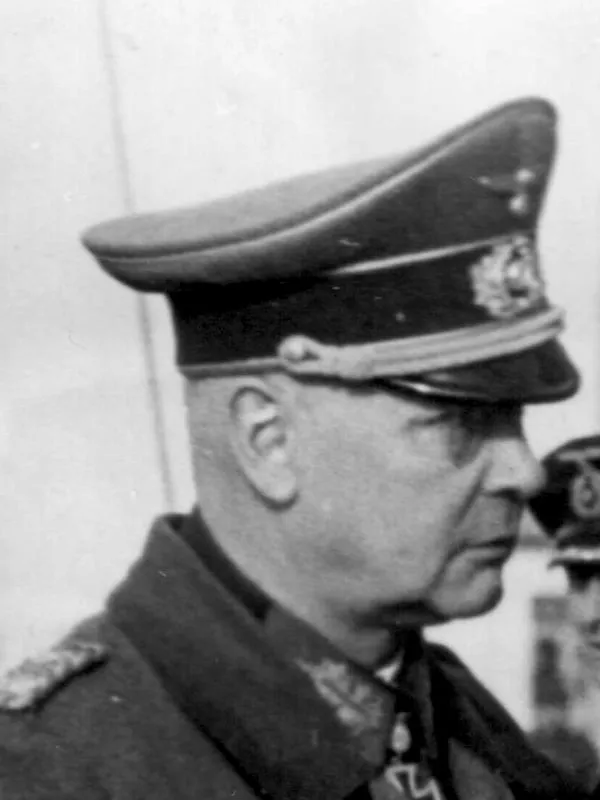
- Born:
- 24 September 1889, Bydgoszcz (Bromberg), Prussia (German Empire)
- Died:
- 19 May 1969, Neumünster (West Germany)
- Author:
- Łukasz
- Photo:
- Mendl, domena publiczna, Wikimedia Commons

Eberhard von Mackensen was a German colonel general and the son of one of the most famous commanders of the First World War. He never won his father’s fame, but in the Second World War his path ran through the Wehrmacht’s most important campaigns in the south: in the summer of 1941 his motorised corps reached the outskirts of Kiev, in November it took Rostov-on-Don, in May 1942 it closed the pocket around Soviet armies at Barvenkovo, and in the autumn it reached the Terek. As commander of the 1st Panzer Army he led it out of the Caucasus, and as commander of the 14th Army he spent five months trying to drive the Allied beachhead at Anzio into the sea. Above all, however, he is remembered as one of the commanders responsible for the shooting of 335 Italians in the Ardeatine Caves in March 1944, for which a British military court sentenced him to death.
The field marshal’s son
Friedrich August Eberhard Mackensen was born on 24 September 1889 in Bydgoszcz, then called Bromberg, the fourth of five children of the cavalry officer August Mackensen and Dorothea, née von Horn. His father, a favourite of Kaiser Wilhelm II, was ennobled in 1899, and from then on the whole family bore the name von Mackensen. Eberhard’s elder brother, Hans Georg von Mackensen, became a diplomat and was the Reich’s ambassador in Rome from 1938 to 1943. Eberhard passed his school-leaving examinations in Gdańsk and, according to German sources, began his service as an officer cadet in XVII Army Corps in October 1908; he was commissioned as a second lieutenant in March 1910.
He began the First World War as adjutant of the 1st Life Hussars, the famous “Death’s Head” hussars of Danzig, whom his father had once commanded. On 23 August 1915 he was badly wounded, and after recovering he served on staffs, among them that of General Friedrich von Scholtz’s army group on the Balkan front. In 1917 he was promoted to captain. After the war he fought with volunteer Freikorps (PL) units in the Baltic states and was then taken into the hundred-thousand-strong Reichswehr.
A cavalryman in the Reichswehr and the Wehrmacht
Mackensen’s interwar career was typical of a cavalry officer from a good family. He served at Belgard (Białogard) in Pomerania, in 1925 worked in the Troop Office in Berlin, and from 1930 served on the staff of the 1st Cavalry Division at Frankfurt an der Oder. After the Nazis came to power he became chief of staff of the cavalry inspectorate, a colonel in 1934, and then chief of staff of X Army Corps in Hamburg. In 1937 he took over the 1st Cavalry Brigade at Insterburg in East Prussia, and on 1 January 1938 he was promoted to major general. On 1 May 1939 he moved to Vienna as chief of staff of General Wilhelm List’s army group command.
List’s chief of staff: Poland and France
In August 1939 List’s command became the 14th Army, which in the September campaign attacked southern Poland from Silesia and Slovakia. Mackensen was its chief of staff: the army took Kraków, crossed the San and reached the approaches to Lwów. In the campaign in France in the spring of 1940 he held the same post in List’s 12th Army, which advanced through the Ardennes behind Ewald von Kleist’s panzer group and later broke the front on the Aisne. On 1 January 1940 he became a lieutenant general, and on 1 August 1940 a general of cavalry.
Mackensen’s corps in Ukraine
On 15 January 1941 Mackensen took over III Army Corps (Motorised), which in Operation Barbarossa fought in Kleist’s 1st Panzer Group, part of Army Group South. After the front in Volhynia was broken, his panzer divisions took Zhytomyr on 8–9 July and were the first to reach Kiev, on the Irpin river. The corps then took part in the battle of Kiev. On 27 July 1941 Mackensen received the Knight’s Cross. At that time part of General Giovanni Messe’s Italian expeditionary corps also fought under his command; he had asked for its divisions himself.
In the autumn the corps advanced east through Zaporizhzhia and along the Sea of Azov. In November, when the wide sweep from the north had stuck in mud and frost, Kleist turned to Mackensen: his divisions struck straight at the city and took Rostov on 21 November 1941, the “gateway to the Caucasus”. They held it for only a week. A Soviet counter-attack forced the Germans to abandon Rostov, which cost Field Marshal Gerd von Rundstedt his command. The battle of Rostov was the first serious defeat of German armour in the east.
In the spring of 1942 Mackensen’s corps stood on the southern edge of the Soviet salient at Barvenkovo. When Marshal Semyon Timoshenko’s troops attacked towards Kharkov on 12 May, Kleist answered with a counter-offensive spearheaded by III Corps with the 14th and 16th Panzer Divisions. Launched on 17 May, the attack closed the Barvenkovo pocket within a few days, and most of the Soviet 6th and 57th Armies were killed or captured in it. For this second battle of Kharkov Mackensen received the Oak Leaves to the Knight’s Cross on 26 May. In June his corps fought in two more preliminary operations before Operation Blue, at Volchansk and Kupiansk.
The Caucasus and the 1st Panzer Army
In the summer of 1942 III Panzer Corps crossed the steppe to the Caucasus with the 1st Panzer Army. In the autumn it reached the Terek, and at the end of October it struck towards Nalchik, which the Romanians fighting alongside it took; at the beginning of November it stood before Ordzhonikidze, today’s Vladikavkaz. This was the furthest point of the German march towards Caucasian oil: a Soviet counter-attack nearly encircled the 13th Panzer Division at Gizel and forced the Germans back. On 22 November, when Kleist took over the whole of Army Group A, Mackensen succeeded him at the head of the 1st Panzer Army.
After Paulus’s troops were encircled at Stalingrad, this army, standing hundreds of kilometres further south, was in danger of being cut off. Hitler long refused to allow a withdrawal, but at the turn of the year he gave way and the Germans began to pull out of the Caucasus. Mackensen conducted the retreat from the Terek according to a plan prepared in advance, from line to line, covered by strong rearguards, and in January 1943 he brought most of his divisions through Rostov before the Red Army could close that passage. In February and March his army took part in Erich von Manstein’s counter-offensive: its XL Panzer Corps smashed General Markian Popov’s mobile group at Krasnoarmeysk, which opened the way to the third battle of Kharkov. On 6 July 1943 Mackensen was promoted to colonel general.
In the autumn of 1943 the 1st Panzer Army defended the Dnieper bend at Zaporizhzhia and Dnipropetrovsk. At the end of October, when Dnipropetrovsk had already been lost, Mackensen handed the army over to General Hans-Valentin Hube and left for Italy.
Anzio
On 5 November 1943 Mackensen took command of the newly formed 14th Army, which was to guard northern Italy and its coasts against a landing. When the Allies landed at Anzio on 22 January 1944, behind the Gustav Line and only a few dozen kilometres from Rome, Field Marshal Albert Kesselring brought his headquarters south. From 25 January Mackensen commanded all the troops around the beachhead, and by early February he had some 100,000 men. The American commander, General John Lucas, failed to exploit the first days, and the Germans had time to seal off the beachhead. When the Allies tried to break out at the end of January, the Germans stopped them at Cisterna and at Campoleone.
The battle of Anzio was the high point of Mackensen’s career as a commander. In early February his troops retook Campoleone and Aprilia, and on 16 February Operation Fischfang began: the main thrust along the road from Albano to Anzio, intended to cut the beachhead in two. The spearhead was the Infantry “Lehr” Regiment, chosen by Hitler. For several days the Germans were a step from success, but Allied artillery, aircraft and warships broke up wave after wave, and the new beachhead commander, General Lucian Truscott, held the final line of defence. On 29 February Mackensen attacked for the last time, from the direction of Cisterna, and again without success. In early March Kesselring persuaded Hitler that further attacks were pointless, and both sides went over to the defensive.
The Ardeatine Caves
On 23 March 1944, in Rome’s Via Rasella, partisans of the communist GAP groups set off a bomb among a marching company of German police; 33 policemen were killed (32 according to the trial report, with a thirty-third dying later). Rome then came under the 14th Army as the immediate rear of the Anzio front, and the city commandant, General Kurt Mälzer, was Mackensen’s subordinate. Hitler’s headquarters demanded bloody retaliation. According to consistent accounts it was Mackensen who, speaking by telephone on the evening of 23 March with Mälzer and the head of the Security Police in Rome, Herbert Kappler, judged a ratio of ten Italians for every German killed to be sufficient and wanted prisoners already sentenced to death to be shot. Kesselring obtained the Wehrmacht high command’s approval for this ratio, and the order to carry out the reprisal within 24 hours went down through Mackensen’s headquarters.
The report of the United Nations War Crimes Commission, based on the trial record, describes what followed: Mackensen asked Mälzer whether there were enough people under sentence of death in the prisons, and Kappler, who ran the prisons, promised to draw up a list of persons “worthy of death”. When the commander of the police battalion that had been attacked and the chief of staff of the 14th Army refused to carry out the executions, they were handed to Kappler’s men. On 24 March 335 men were murdered in the Ardeatine Caves, among them political prisoners, civilians seized at random and several dozen people of Jewish origin; the youngest was 14. Most of them had not been sentenced to death, and, as Kappler himself admitted, only four had any connection with the bombing. Kappler reported the completion of the task to Mälzer and Mackensen, who passed the report on to Kesselring’s headquarters.
Dismissal
On 11 May 1944 the Allies launched their great offensive against the Gustav Line and took Monte Cassino, and on 23 May the troops at Anzio broke out of the beachhead and linked up with the southern front. Mackensen then made a mistake that cost him his command. As the American official history of the campaign describes, at the end of May a gap opened in the German “Caesar” line on the Monte Artemisio massif, at the junction of his two corps. On 29 May Kesselring ordered it closed, but Mackensen and his corps commanders believed the matter had been dealt with and did not report the gap. During the night of 30–31 May the American 36th Division passed through it into the German rear at Velletri.
Relations between Kesselring and Mackensen had long been strained. For the third time since February Mackensen placed his command at his superior’s disposal, and Kesselring, who already had Hitler’s permission, this time accepted. A few days later Mackensen handed the 14th Army over to General Joachim Lemelsen and left for Germany; meanwhile the Allies entered Rome. He received no further posting until the end of the war.
Trial and final years
After the Reich capitulated, Mackensen became a British prisoner. From 18 to 30 November 1946 a British military court in Rome tried him together with Mälzer. Neither pleaded superior orders in the strict sense; instead they argued that the reprisal was justified by a wave of attacks in the city, that they had tried to limit it to condemned prisoners, and that they were not responsible for the manner of the executions, which had been entrusted to the Security Police. The court found them guilty and sentenced them to death by shooting. The sentences were commuted to imprisonment: the Commission’s report gives life imprisonment, while German and English biographies speak of 21 years. Mälzer died in prison in 1952, and Mackensen was released on 2 October of the same year, as was Kesselring, who had also been sentenced to death for the same crime.
Mackensen spent the rest of his life in seclusion at Alt Mühlendorf near Nortorf in Schleswig-Holstein. He died on 19 May 1969 in Neumünster. Militarily he was a competent corps and army commander who did best in well-planned operations such as the Barvenkovo pocket or the retreat from the Caucasus; at Anzio he was beaten by Allied superiority in the air and at sea, and by his own lack of vigilance in the decisive days of May 1944. Today his name is linked above all with the Ardeatine Caves: he was one of three German generals convicted for the deaths of the 335 people murdered in the reprisal.
Sources
Commanded in battles
(01)Mentioned in battles
(05)Often appears with
People who appear in the same events.