Germany
Johannes Blaskowitz
Commander of the Eighth Army (1939), Commander-in-Chief East in occupied Poland (1939–1940), commander of the First Army in France (1940–1944), Army Group G (1944–1945) and Army Group H in the Netherlands (1945)
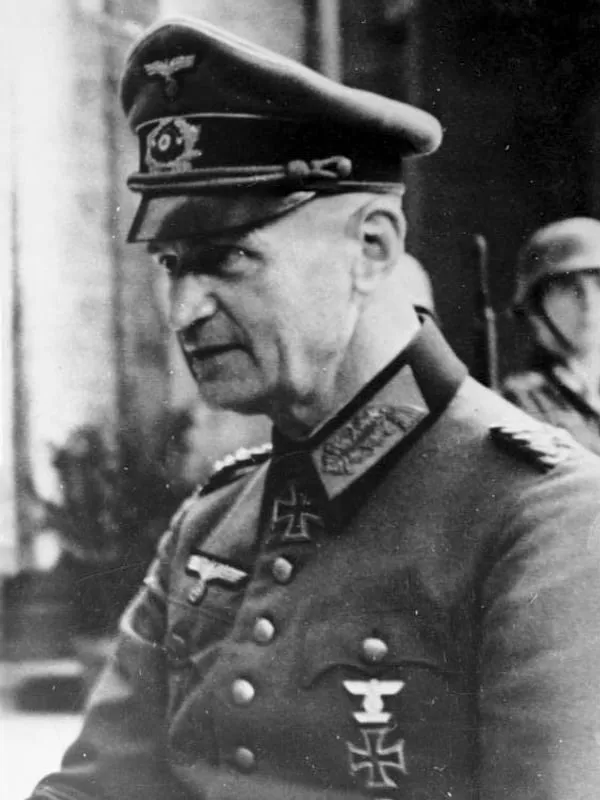
- Born:
- 10 July 1883, Paterswalde, East Prussia (German Empire), today Bolshaya Polyana (Russia)
- Died:
- 5 February 1948, Nuremberg (Germany)
- Author:
- Natalia
- Photo:
- Schulz, Erwin, CC BY-SA 3.0 DE, Wikimedia Commons

Johannes Blaskowitz was one of the three German army commanders whose armies attacked Poland from the south in September 1939. His Eighth Army took the brunt of the Polish attack on the Bzura and then besieged Warsaw, whose surrender Blaskowitz accepted on 28 September. As Commander-in-Chief of the German forces in occupied Poland he became known for memoranda in which he described the murders committed by the SS and police against Poles and Jews. Hitler never forgave him: Blaskowitz was the only colonel general of the time not to be made a field marshal in 1940. Even so, he kept returning to ever higher posts: he defended southern France against the Allied landing, led the last German offensive in Alsace and in May 1945 surrendered the German forces in the Netherlands. He took his own life in Nuremberg on the day the trial in which he was one of the defendants opened. His protests of 1939 are disputed to this day: some see courage in them, others a concern for the army’s discipline rather than for the victims.
A pastor’s son from East Prussia
Johannes Albrecht Blaskowitz was born on 10 July 1883 in the village of Paterswalde near Wehlau (today Znamensk (PL)) in East Prussia; the village is now called Bolshaya Polyana and lies in the Kaliningrad oblast. He was the son of a Protestant pastor, Hermann Blaskowitz, and Marie, née Kuhn, who died when he was three. At the age of eleven he went to the cadet school in Köslin (Koszalin), and then to the main cadet institute at Berlin-Lichterfelde. In 1901 he joined the 18th Infantry Regiment in Osterode (Ostróda) as an officer cadet, and the following year he was commissioned as a second lieutenant. Before the war he attended the War Academy in Berlin.
He began the First World War as a captain and company commander. He fought in Lorraine and Flanders, in the Tyrol and in Serbia, and from 1916 served as a General Staff officer on the Eastern Front, among other places at Kovel and Riga, and in the West. He received both classes of the Iron Cross and the Knight’s Cross of the House Order of Hohenzollern with Swords.
The apolitical soldier
In the Reichswehr Blaskowitz served mainly in Württemberg and Baden. He took part in putting down communist risings in the early 1920s, commanded a battalion in Ulm, was chief of staff of the 5th Division in Stuttgart and, from the end of 1930, commander of the 14th Infantry Regiment in Konstanz, where his men and the townspeople valued him for his openness. On 1 October 1932 he became a major general. He was seen as a typical officer who had no love for the Weimar Republic but believed that the army should stand above politics; he greeted Hitler’s accession to power with indifference and would not discuss politics even with his family.
In 1933 he became Inspector of Military Schools in Berlin and a lieutenant general, in 1935 commander of Military District II in Stettin, and in 1936 General of Infantry. In 1938 he took over Army Group Command 3 in Dresden, one of the highest posts in the army. His troops entered the Sudetenland in the autumn of 1938, and on 15 March 1939 they occupied Bohemia and Prague.
The Bzura and Warsaw
In the September Campaign Blaskowitz commanded the Eighth Army, the left wing of Gerd von Rundstedt’s Army Group South. It advanced from Silesia on Łódź, to the north of Walter von Reichenau’s Tenth Army. While its main forces were heading for Warsaw, on 9 September the Poznań and Pomorze Armies of General Tadeusz Kutrzeba struck from the Bzura at its overstretched northern flank and routed the 30th Infantry Division. So began the Battle of the Bzura, the largest battle of the campaign. Blaskowitz turned part of his forces round and halted the Polish attack near Łęczyca and Stryków, while Rundstedt and his chief of staff, Erich von Manstein, decided to trap the Polish armies in a pocket. Hitler, who visited the front, was dissatisfied with Blaskowitz’s handling of the battle, but it was to him that he entrusted the capture of Warsaw.
The Eighth Army was to take left-bank Warsaw by 3 October at the latest. According to the American study of the campaign, on 22 September Hitler instructed Blaskowitz not to let civilians leave the encircled city: hunger, thirst and casualties among the inhabitants were meant to break the defence more quickly. On 25 September, “Wet Monday”, thousands of bombs and shells fell on the city, and Blaskowitz’s infantry took the outer forts. After two days of assault General Kutrzeba opened talks, and on 28 September he and Blaskowitz signed the surrender of Warsaw at Rakowiec, ending the defence of the capital. On 1 October Blaskowitz received the officers of the Warsaw Army staff and praised their soldierly conduct. For the campaign he received the Knight’s Cross of the Iron Cross and promotion to colonel general.
Polish researchers point out that in the Eighth Army’s sector, too, Wehrmacht soldiers shot prisoners and civilians; studies of Wehrmacht crimes in Greater Poland during the period of military administration hold the commands of the Eighth and Fourth Armies responsible. After the war Poland placed Blaskowitz on the wanted list of the United Nations War Crimes Commission.
The memoranda
On 20 October 1939 Blaskowitz succeeded Rundstedt as Commander-in-Chief East (Oberbefehlshaber Ost), that is, commander of the German forces in occupied Poland. A few days later the military administration handed civil power to Hans Frank in the new General Government. Behind the army came the Einsatzgruppen, the police and the Selbstschutz made up of local ethnic Germans, which in Operation Tannenberg and the Intelligenzaktion murdered the Polish intelligentsia, priests and Jews.
In November 1939 Blaskowitz sent his first memorandum on the crimes of the SS and police to the Commander-in-Chief of the Army, Walther von Brauchitsch. Brauchitsch passed it on to Hitler, who reportedly flew into a rage, called the general’s objections childish and declared that wars are not won with Salvation Army methods. Blaskowitz did not back down. He had several members of the SS and police sentenced by military courts for crimes against civilians, but the sentences were quashed. On 8 December he sent another report, which the Abwehr officer Helmuth Groscurth showed to commanders on the Western Front, and in February 1940 he compiled several dozen documented cases of violence: rapes, looting, the public flogging of hundreds of Jews in Nasielsk. He warned that the soldiers looked on the SS and police with revulsion and hatred, and that men who had learned to murder might one day turn against their own people. In notes for a meeting with Brauchitsch on 15 February he wrote that it was a mistake to slaughter tens of thousands of Jews and Poles, because this would neither destroy the idea of a Polish state among the population nor wipe out the Jews.
The effect was the opposite of what he intended. Brauchitsch refused to pass the new complaints on to Hitler and issued an order asking officers to show understanding for “necessary political tasks”, and in March he invited Heinrich Himmler to explain himself to the army group commanders. Frank, Himmler and Reinhard Heydrich all worked against Blaskowitz. In May 1940 he lost his post.
Historians judge the memoranda differently. It was one of the sharpest military protests against the crimes in Poland, but Raul Hilberg believed that what outraged Blaskowitz was not the aim itself but the amateurish way in which the SS went about it. Omer Bartov drew attention to the ambiguity of a text that could also be read as a call for killing in a more orderly way, and the authors of studies of the Einsatzgruppen in Poland stress that Blaskowitz still regarded Poles and Jews as Germany’s enemies. His arguments were shaped by concern for discipline, the army’s prestige and the political damage done by the occupation; writing for Hitler, he knew in any case that a moral appeal stood no chance.
The occupation of France
In May 1940 Blaskowitz was to take over the Ninth Army, but at Hitler’s demand he was removed after a few weeks. For two weeks in June he was military commander in northern France, and in July, when Hitler made a whole series of generals field marshals, he was passed over. At the end of October 1940 he took over the First Army, which defended the Atlantic coast from Brittany to the Pyrenees. On 11 November 1942 his troops took part in Operation Anton, the occupation of the hitherto unoccupied part of France; they failed, however, to seize the fleet at Toulon, which the French scuttled.
In May 1944 Blaskowitz took over the new Army Group G, made up of the First and Nineteenth Armies, which was to defend the south of France. The armed resistance was growing fast, and Blaskowitz fought it hard. The British historian Christopher Clark notes that after the Oradour-sur-Glane massacre Blaskowitz dissociated himself in an order of the day from the SS division “Das Reich”, but when the French authorities complained of the killing of civilians by the SS, he replied that in such a struggle the death of innocent people was unavoidable. After the 20 July plot he assured Hitler of his loyalty. He never joined the resistance; Ulrich von Hassell, who spoke with him in 1943, noted that Blaskowitz saw everything purely through a soldier’s eyes.
From the Riviera to Alsace
When the Allies landed in Provence in Operation Dragoon on 15 August 1944, Blaskowitz knew he could not throw them back: his best divisions had been taken away to Normandy. Permission to retreat came late, but he led most of his forces out to the north, although Toulon and Marseille fell and the Nineteenth Army lost many men in the Rhône valley. At the beginning of September his rearguards held out near Dijon, through which the last columns from south-western France were passing. For this withdrawal he received the Oak Leaves to the Knight’s Cross.
In Lorraine Hitler ordered him to counter-attack George Patton’s Third Army. Blaskowitz thought this a mistake but carried out the order; Nancy had already been given up on 13 September, and the tank battles at Arracourt on 19–20 September cost the Germans heavily. On 21 September 1944 Hitler replaced him with General Hermann Balck. After the war Blaskowitz judged that Patton had needlessly become embroiled in the fight for the fortress of Metz instead of bypassing it.
In December 1944 Blaskowitz again took over Army Group G, to prepare a blow in Alsace that was meant to draw the Americans away from the Ardennes. On New Year’s Eve Operation Nordwind began, the last German offensive in the West. It was hampered by divided command: the other part of the forces came under Himmler, who answered only to Hitler. The Germans pushed the American VI Corps back to the Moder river, but they neither destroyed the Seventh Army nor retook Strasbourg. At the end of January 1945 Blaskowitz was replaced by General Paul Hausser.
The Netherlands
At the end of January 1945 Blaskowitz took over Army Group H on the lower Rhine from General Kurt Student. In March its troops were unable to stop Montgomery’s armies crossing the Rhine. At the beginning of April, when the Canadians cut off the western Netherlands, Blaskowitz took command of “Fortress Holland” with the Twenty-Fifth Army. The western Netherlands was living through the last weeks of the Hunger Winter, in which, according to the most commonly cited estimates, some 20,000 people died. Blaskowitz agreed to a de facto ceasefire and to food drops for the population in Operations Manna and Chowhound. On 25 April he received the Swords to the Knight’s Cross. On 5 May, at the Hotel “De Wereld” in Wageningen, in the presence of Prince Bernhard, he received the surrender terms from the Canadian General Charles Foulkes; the document was signed the following day.
Nuremberg
After the war Blaskowitz was held at Dachau, at Allendorf near Marburg and in Nuremberg. The Americans indicted him in the High Command Trial for crimes against peace, war crimes and crimes against humanity. The charges included passing on the Commando Order to his subordinates and responsibility for the murder of 31 British paratroopers near Poitiers in July 1944 by a corps under his command. Blaskowitz pleaded not guilty. On 5 February 1948, the day the trial opened, he broke away from his guards and jumped from a balcony into the courtyard of the Palace of Justice. He was buried in Bommelsen in Lower Saxony, where his wife and daughter had found refuge after the war.
Verdict
Christopher Clark believes that Blaskowitz could have counted on an acquittal, and according to some historians the Nuremberg judges pointed to him as an example of how Wehrmacht officers could have behaved. An older German biography saw him as a tragic figure: a general who fell foul of Hitler and Frank and yet served to the end. From a Polish perspective it must also be remembered that it was his army that took Warsaw at the cost of thousands of civilian lives, and that his protests in Poland, genuine and brave as they were, did not stop the killing. Perhaps Clark describes him best: his professionalism allowed him to uphold his own principles against the spirit of the age, but the same professionalism made him incapable of political resistance.
Sources
Commanded in battles
(04)Mentioned in battles
(03)Often appears with
People who appear in the same events.
On the timeline
(18)1939
March
September
- 01
- Key eventGermany invades PolandAt dawn on 1 September 1939 the Wehrmacht attacked Poland from the north, west and south without declaring war. The Slovak army struck alongside the Germans.
- Operation TannenbergOn 1 September 1939 Security Police and SD Einsatzgruppen followed the Wehrmacht into Poland, carrying lists of names to “neutralise” Poland’s leading strata.