Germany
Paul Hausser
Commander of the SS-Verfügungstruppe division “Das Reich” (1939–1941), II SS Panzer Corps (1942–1944), the Seventh Army (1944) and Army Group G (1945)
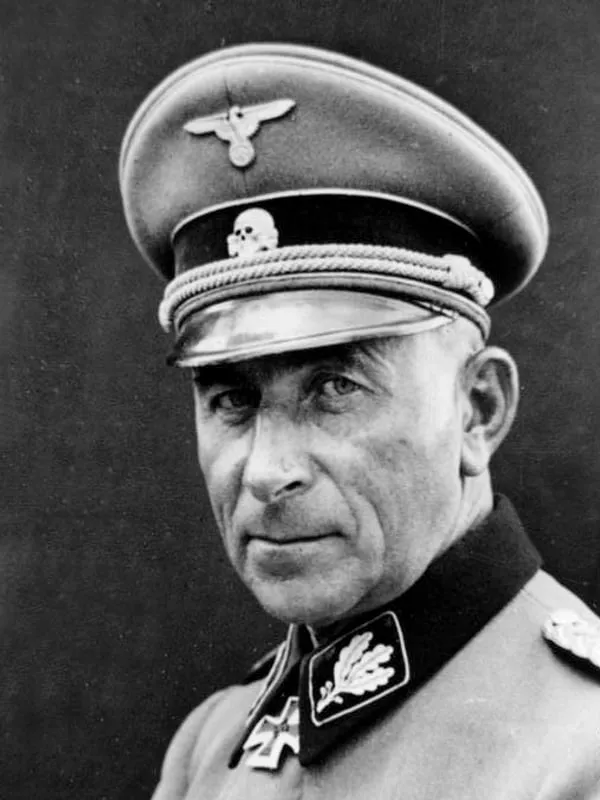
- Born:
- 7 October 1880, Brandenburg an der Havel (Germany, Kingdom of Prussia)
- Died:
- 21 December 1972, Ludwigsburg (West Germany)
- Author:
- Łukasz
- Photo:
- autor nieznany, CC BY-SA 3.0 DE, Wikimedia Commons

Paul Hausser was a professional officer of the Prussian General Staff who in retirement threw in his lot with the SS and turned its armed units into an army. It was he who taught the Waffen-SS the soldier’s trade, commanded its first division and then its first panzer corps, with which in February 1943 he abandoned Kharkov against Hitler’s orders, only to retake it a month later. He was the first SS officer to command a field army, the Seventh Army in Normandy, and he led its remnants out of the Falaise pocket. After the war, never charged, he spent twenty years persuading Germans that the Waffen-SS had been made up of “soldiers like any other”. That claim, now rejected by historians, owes much of its staying power to him.
General Staff officer
He was born on 7 October 1880 in Brandenburg an der Havel, the son of a Prussian major. In 1892 he entered the cadet corps, and in 1899 he was commissioned as a lieutenant in the 155th Infantry Regiment. He graduated from the War Academy in Berlin and in 1912 was posted to the Great General Staff. In the First World War he served on staffs, from 1916 mainly with the 109th Infantry Division on the Eastern Front, and ended it as a major. After the war he fought with the Grenzschutz Ost units on Germany’s eastern border and then stayed on in the hundred-thousand-strong Reichswehr. He commanded a battalion, was chief of staff of the military district at Stettin and commanded the 10th Infantry Regiment. In 1931 he became a major general, and at the end of January 1932 he retired with the honorary rank of lieutenant general.
In the service of the SS
The pensioner soon found a new occupation. In 1933 he joined the Stahlhelm veterans’ league, which was absorbed into the SA after Hitler came to power. In November 1934 he moved to the SS and took over the cadet school at Brunswick, which trained officers for Heinrich Himmler’s armed units. In 1936 he became Inspector of the SS-Verfügungstruppe, responsible for its training though not for its deployment, which was Himmler’s decision. Out of a few regiments of ideologically selected volunteers, until then more party police than soldiers, Hausser began to build a force fit for war, trained on army lines. In 1937 he joined the Nazi Party.
In the September campaign of 1939 he observed the operations of the mixed Panzer Division “Kempf”, in which SS regiments fought. In October 1939 he took command of the first SS division, the SS-Verfügungsdivision, later renamed “Das Reich”. He led it in the French campaign in 1940, in the spring of 1941 in the invasion of Yugoslavia and in Operation Barbarossa as part of Army Group Centre. In August 1941 he was awarded the Knight’s Cross. In October, during the advance on Moscow, he was severely wounded and lost an eye; from then on he wore a black patch over it. His soldiers called him “Papa Hausser”.
Kharkov and Kursk
In the summer of 1942 Hausser was given the task of forming an SS panzer corps from the divisions “Leibstandarte SS Adolf Hitler”, “Das Reich” and “Totenkopf”. In November 1942 his troops took part in the occupation of Toulon, where the French fleet scuttled itself rather than fall into German hands. At the beginning of 1943 the corps was sent to the Eastern Front, to defend Kharkov, which Hitler ordered to be held at all costs.
When in February the Red Army began to encircle the city, Hausser concluded that further resistance would end for his divisions as it had for the Sixth Army at Stalingrad. On 15 February, against the orders of Hitler and of his superior, General Hubert Lanz, he led his troops out of Kharkov. It was Lanz who paid for this act of insubordination and was dismissed a few days later; Hausser escaped punishment, although according to some authors the award of his Oak Leaves was held back for several months as a penalty. The corps soon became the main battering ram of Field Marshal Erich von Manstein’s counter-offensive. In the Third Battle of Kharkov Hausser, instead of bypassing the city as the commander of the Fourth Panzer Army, Hermann Hoth, wanted, threw his SS divisions into an assault and, after several days of street fighting, retook Kharkov on 15 March. According to German researchers, SS units committed crimes against prisoners and civilians at the time.
In July 1943 the corps, renamed II SS Panzer Corps, attacked on the southern flank of the Battle of Kursk. Its three divisions broke through the first Soviet defence belts and from 9 July turned towards Prokhorovka, where the attack stalled in the clash with the 5th Guards Tank Army. On 28 July Hausser received the Oak Leaves to his Knight’s Cross.
Italy and Ukraine
After Kursk the corps headquarters was moved to northern Italy, where it was to take control of the country if Badoglio’s government broke the alliance. After Italy’s capitulation in September 1943 its units disarmed the Italian forces. On 19 September a battalion of the “Leibstandarte” under Joachim Peiper burned the Piedmontese villages of Boves and Castellar, killing many of their inhabitants. A corps report described them as supply bases for “bandits”; Hausser never expressed any regret over it and to the end of his life denied that his subordinates had committed crimes.
Rebuilt with the new divisions “Hohenstaufen” and “Frundsberg”, II SS Panzer Corps returned to the east in the spring of 1944 and in April fought in Podolia, around Tarnopol, where it helped to relieve encircled German forces. In June, after the Allied landings, it was transferred to France.
Normandy
The corps took two weeks to reach the front, travelling largely by night to avoid Allied aircraft. As it arrived in Normandy, the commander of the Seventh Army, General Friedrich Dollmann, died on 28 June, officially of a heart attack. The corps’ counter-attack on the British near Caen the next day was broken up by artillery, air and naval fire. Hitler appointed Hausser commander of the Seventh Army: he was the first SS officer to command a field army. In the Battle of Normandy his army held the western part of the front, against the Americans, in the hedgerow country around Saint-Lô. Hitler rejected his requests to shorten the line, so Hausser switched to a defence in depth.
On 25 July the Americans launched Operation Cobra. After a carpet bombing their tanks broke through the Seventh Army’s front and drove south towards Brittany. In early August Hausser agreed to the withdrawal of the Rennes garrison, which was in danger of being cut off. Hitler, however, forced him into a counter-attack at Mortain, intended to cut the American corridor to Avranches. The attack of 7 August collapsed, and the German forces found themselves in a sack between the Americans to the south and the Canadians and Poles to the north. When Hitler replaced Field Marshal Günther von Kluge with Walther Model, Model gave Hausser command of the troops in the Falaise pocket and ordered him to lead them out across the river Dives. During the breakout, around 20–21 August, Hausser was badly wounded in the face by a shell splinter and escaped from the pocket riding on a tank. For Normandy he received the Swords to his Knight’s Cross, and from 1 August he held the highest rank of the Waffen-SS, SS-Oberst-Gruppenführer, which in the Waffen-SS was otherwise held only by Sepp Dietrich.
Army Group G
Once recovered, at the end of January 1945 Hausser replaced General Johannes Blaskowitz at the head of Army Group G in Alsace and on the Saar. He took over troops bled white in Operation Nordwind and the divisions trapped in the Colmar Pocket, which the Allies cleared at the beginning of February. In March his two armies defended the Palatinate against the American and French advance, while Hitler forbade them to retreat across the Rhine. The Americans shattered the defence of the Palatinate, Army Group G suffered enormous losses, mostly in prisoners, and at the end of March the Allies crossed the Rhine in its sector too, at Oppenheim. In early April Hitler dismissed Hausser. Joseph Goebbels noted at the time that the general had “definitely not stood the test”. Hausser spent the rest of the war without a post on the staff of Field Marshal Albert Kesselring.
After the war
In May 1945 Hausser surrendered to the Americans at Zell am See in Austria. He spent several years in internment camps, including Dachau. In 1946 he testified at the Nuremberg trial as the most important defence witness for the Waffen-SS: he claimed that it had been a purely military force, like the Wehrmacht, with no connection to the crimes of the SS. He was never charged. He wrote operational studies for the US Army’s historical division, in a team led by Franz Halder; his study of the Seventh Army’s battles in Normandy was published in English in 2004. He was released in 1949 (some sources say 1948).
In 1950–1951 Hausser co-founded HIAG, a mutual aid organisation of former Waffen-SS soldiers, and became its first spokesman. He campaigned for pension rights for its members, which the Bundestag granted in 1961. He published two books, “Waffen-SS im Einsatz” (1953), with a foreword by Heinz Guderian, and “Soldaten wie andere auch” (1966). In them he argued that the Waffen-SS had been an apolitical, elite and European army, innocent of crimes. He passed over the fact that its divisions had also drawn their cadres from the “Totenkopf” units that guarded the concentration camps. In 1960 the first book was placed on the list of publications harmful to young people.
He died on 21 December 1972 in Ludwigsburg. Thousands of former SS men attended his funeral at the Waldfriedhof cemetery in Munich.
Assessment
As a commander Hausser was among the ablest generals the Waffen-SS had. He brought with him the General Staff training and experience that many of its commanders lacked, and the courage to defy Hitler at Kharkov. In Normandy he was given an army that could not be saved and carried out orders in which he himself did not believe. His more lasting work, however, turned out to be a legend. Historians, among them Bernd Wegner, have shown that the Waffen-SS was an integral part of the SS apparatus and that its units committed numerous crimes in the east, in Italy and in France. Hausser, who taught it to fight, did everything after the war to make people forget this.
Sources
Commanded in battles
(02)Mentioned in battles
(04)Often appears with
People who appear in the same events.